Sunday, January 27, 2013

How Much is a Marketing Asset Management Solution Worth?

Pressed by senior business executives to maximize the return on marketing spend, astute marketers are aggressively seeking ways to boost the productivity of marketing operations. They now recognize that increasing the efficiency of marketing operations can be a powerful way to stretch limited marketing budgets.

In response to these demands, many marketers are turning to marketing asset management solutions to streamline and enhance the productivity of the marketing supply chain. MAM solutions can enable companies to eliminate costs, significantly reduce obsolescence waste, and expand the use of customized, more relevant marketing messages and materials. For companies with distributed marketing models, MAM solutions can also enhance the marketing efforts of sales channel partners.

Despite these powerful benefits, however, many marketing and financial executives don't have a clear picture of how valuable a marketing asset management solution would be for their company.

How Marketing Asset Management Solutions Create Value

For a business organization, the value of any product or service is ultimately based on how it affects bottom-line financial performance. The best definition of value in a B2B setting is the total monetary worth of the benefits that a company obtains by purchasing and using a product or service. Essentially, this means that a product or service can create value for a business in three basic ways. It can enable the business to reduce existing costs, avoid future costs, or increase revenues. The value of a marketing asset management solution is based on these same factors.

MAM solutions will provide two broad types of benefits for most companies. One group of benefits includes those that improve the efficiency of the marketing supply chain. These benefits create value primarily by enabling a company to reduce existing costs or avoid future costs. The second group of benefits includes those that improve the effectiveness of a company's marketing campaigns and programs. These benefits create value primarily by enabling a company to increase revenues.

To estimate the value of a marketing asset management solution for your business, you'll need to identify the benefits you'll obtain from the solution and then quantify the value of each benefit. The diagram below shows some of the marketing value chain benefits that companies typically obtain by using a marketing asset management solution.


I've just released a white paper that describes the benefits that a marketing asset management solution typically provides and explains how to measure the value of these benefits. If you'd like to obtain a copy of this resource, send an e-mail to ddodd(at)pointbalance(dot)com.

Saturday, January 19, 2013

Why Hasn't Traditional Marketing Died?

In marketing circles, it's been fashionable for several years to proclaim the impending demise of traditional advertising and marketing tactics. Marketing thought leaders have advanced this view in many of the best known and most influential marketing books published during the past two decades. For example:
  • 1993 - Don Peppers and Martha Rogers, The One To One Future - "We are facing a paradigm shift of epic proportions - from the industrial era to the Information Age. As a result, we are witnessing a meltdown of the mass-marketing paradigm that has governed business competition throughout the twentieth century."
  • 1999 - Seth Godin, Permission Marketing - In this book, Godin argued that all forms of "interruption marketing" have become ineffective, primarily due to the amount of advertising and marketing clutter that fills the environment. Godin wrote, "Is mass marketing due for a cataclysmic shakeout? Absolutely."
  • 2007 - David Meerman Scott, The New Rules of Marketing and PR - Scott argued that the Internet enables organizations to "disintermediate" traditional advertising and marketing methods and reach potential customers directly with low-cost, informative, and interactive online content. He called traditional advertising "A Money Pit of Wasted Resources."
  • 2010 - Brian Halligan and Dharmesh Shah, Inbound Marketing - "For the last 50 years, companies such as Procter & Gamble, IBM, and Coca-Cola used large amounts of money to efficiently interrupt their way into businesses and consumer's wallets using outbound marketing techniques. The outbound marketing era is over. The next 50 years will be the era of inbound marketing."
Based on these predictions (and many others like them), we would expect to see the use of traditional advertising and marketing methods in a free fall. But that isn't happening. According to a forecast published by ZenithOptimedia in December 2012, worldwide advertising spending will grow from about $482 billion in 2011 to almost $574 billion by the end of 2015. In North America, the firm expects advertising spending to grow from $165 billion in 2011 to $195 billion in 2015.

These estimates cover spending in seven types of media - newspapers, magazines, television, radio, cinema, outdoor, and Internet. Except for the Internet, all of this spending relates to traditional advertising and marketing tactics. According to ZenithOptimedia, the Internet will be second largest category of advertising spending by 2013, but it will still lag behind television by a significant margin (19.8% of total spending for the Internet vs. 40.1% of total spending for TV).

In addition, Winterberry Group has estimated that spending on direct mail (another traditional marketing method) has enjoyed modest annual growth since 2009.

So, what's going on? Were Don Peppers, Martha Rogers, Seth Godin, David Meerman Scott, Brian Halligan, Dharmesh Shah, and many others simply wrong? I don't think so, at least not completely. The projections by ZenithOptimedia and research by Forrester and other firms clearly show that digital marketing, content marketing, social media marketing, and inbound marketing are the fastest growing segments of the marketing industry. And to some extent anyway, they are growing at the expense of more traditional marketing methods and tactics.

It's also clear, however, that many companies - particularly consumer products companies and large B2B firms - are not close to abandoning traditional advertising and marketing methods, even if the effectiveness of those methods is questionable.

I suspect that the relative slowness of change results from a combination of factors.
  • Inertia - There's a lot of inertia in human organizations, especially in large companies. Even when company leaders believe change is needed, it is often implemented gradually and incrementally.
  • Fear - Probably the primary cause of inertia. Even when company leaders recognize the need for change, the fear of the unknown and/or the fear of making a mistake can deter them from implementing change. ("Better the devil you know . . .")
  • Traditional advertising/marketing still works (sort of) - Some marketers may perceive that traditional advertising and marketing methods are still at least somewhat effective, and perhaps they actually are for some companies.
Whatever the cause, traditional advertising and marketing tactics and methods are likely to be with us for quite some time.

Sunday, January 13, 2013

Should Marketing or Sales Lead Demand Generation?

Over the past few years, two distinct approaches to B2B demand generation have emerged. Both of these models have evolved in response to profound changes in the B2B marketing and sales environment, the most significant of which has been the appearance of empowered buyers.

Business buyers now have access to a wealth of online information, and they are using that information to perform research on their own. As a result, they are much less dependent on sellers than in the past, and they're avoiding interactions with sales reps until later in the buying process. Research by the Corporate Executive Board, SiriusDecisions and others has shown that prospects are often 50% to 60% through the buying process before they engage with a salesperson.

One approach to dealing with empowered buyers is to expand the role of marketing in B2B demand generation. Not surprisingly, the strongest early advocates of this model were providers of B2B marketing automation software like Marketo, Eloqua, Hubspot, and several others. The second approach argues that what is needed is a new sales methodology. The Corporate Executive Board is a strong advocate of this model, and two CEB executives, Matthew Dixon and Brent Adamson, provided a detailed description of this model in their best-selling book, The Challenger Sale.

The marketing-centric model accepts that most potential buyers prefer to access information about business issues and potential solutions on their own, especially in the early stages of the buying process. Instead of fighting this preference, the marketing-centric model seeks to support the "self-directed buyer" as he or she goes through the learning process. The marketing-centric model relies heavily on content marketing principles and techniques (because it assumes that most early-stage interactions need to be content based), and it leverages technology to manage and execute activities such as lead nurturing and lead qualification.

The "new sales methodology" model emphasizes the continued importance of sales reps in the demand generation process. What CEB and others argue is that salespeople should engage with early-stage buyers and use disruptive insights to change how they think about their business. To use CEB's teminology, these disruptive insights enable sales reps to shape emerging demand rather than simply react to established demand. More importantly, these insights provide value that buyers can't get anywhere else and thus make it necessary (or at least very worthwhile) for buyers to engage with the sales rep.

Which of these demand generation models will ultimately prevail? My answer is neither and both. Neither model will completely win because both will (and should) be used.

Many proponents of both models now recognize the value of the other approach. Advocates of the marketing-centric model now acknowledge that human involvement with early-stage buyers can be very valuable, and CEB is expanding its concept of disruptive insights to include marketing content as well as sales messaging.

The bottom line is that neither marketing nor sales should "own" B2B demand generation. Effective demand generation requires marketing and sales to function as an integrated team.

Sunday, January 6, 2013

Will Your Marketing Content Help You "Make the Cut?"

I'm not a big fan of professional golf, although I do watch at least part of the four "major" tournaments that are held each year. As I was watching last year's US Open, it occurred to me that B2B demand generation and professional golf have something in common.

As most of you probably know, professional golf tournaments typically consist of 72 holes, with contestants playing four 18-hole rounds over four days. After 36 holes (two rounds) are completed, the tournament field is reduced by eliminating the players with the worst scores. The "cut," as it's called, can sometimes eliminate almost half of the players. To have a chance to win a tournament, the first thing a player must do is "make the cut."

One of the truisms in golf is that you can't win a tournament on the first day, but you can lose it. Because the scores are cumulative, a bad performance on the first day can put you so far behind that it's all but impossible to catch up. A really bad performance on Day 1 may cause you to "miss the cut" and not even have a chance to play in the final two rounds.

For B2B companies that have complex and lengthy sales cycles, demand generation resembles a professional golf tournament. The buying process can extend for several weeks to several months and typically includes multiple buying stages. At several points along the purchase journey, prospects make decisions about which potential suppliers to consider. If your company doesn't "make the cut" at any of these decision points, you won't be in the game when the final buying decision is made.

The critical point here is that prospects are increasingly making these decisions before they've had a person-to-person interaction with anyone in your company. According to research by the Corporate Executive Board, SiriusDecisions, DemandGen Report, and others, the average prospect is 50% to 60% through the buying process before he or she meets with a sales rep.

So how do prospects decide which potential sellers to consider? To a great extent, these decisions are based on what prospects learn about and from a potential seller when they take initial steps to get information about the products or services they may be interested in purchasing. This is what Google has called the Zero Moment of Truth.

Most of this early research is performed online, via web searches, anonymous visits to company websites, reading or viewing online content resources provided by prospective sellers, reading online user reviews, and, increasingly, interacting with peers via social media.

This new buyer behavior means that what is said about and by your company online plays a critical role in your demand generation success. While you can't control what others say about your company, you can control the quality of the content you publish. If the content you provide demonstrates that you understand your prospects' problems and that you have the requisite expertise to help solve those problems, your odds of beginning a meaningful sales conversation with those prospects will be a lot higher.

What about your marketing content? Will it help you "make the cut" and stay in the game as your prospects move closer to a buying decision?

Wednesday, January 2, 2013

What is a "Sales-Ready Lead?"

One of the most important requirements for an effective B2B demand generation system is a clear understanding of who constitutes a sales-ready lead. Decribing who is a sales-ready lead is the essential starting point for defining the roles and aligning the work of marketing and sales. In an optimized demand generation system, marketing is primarily responsible for acquiring new leads and for nurturing leads until they are sales ready. Once a lead becomes sales ready, sales assumes the primary responsibility for managing that relationship.

The term sales-ready lead can be found in many books, articles, and blog posts, but it's surprisingly difficult to find a definition that's really useful. I'll offer one momentarily, but first it's important to understand what a sales-ready lead is not. A raw inquiry does not constitute a sales-ready lead. A raw inquiry is someone who has shown only a minimal level of interest in what you offer. He or she may have responded to an outbound lead generation campaign or visited your website and filled out a registration form, but that's it. The problems caused when marketing passes raw inquiries to sales have been widely discussed in the demand generation literature, so I won't repeat them here.

Sales ready is also not equivalent to ready to buy. Some people suggest that sales-ready leads are only those leads who are fully qualified using tradtional BANT criteria. In an earlier post, I discussed why BANT is no longer an effective framework for qualifying leads. The basic problem with BANT is that some of the criteria will not be met until near the end of the buying process, and in addition, it can be impossible for any individual lead to satisfy all of the BANT requirements.

A sales-ready lead, therefore, falls somewhere between a raw inquiry and a BANT-qualified lead. Here's my proposed definition:

A sales-ready lead is an individual who (a) is affiliated with a qualified prospect, (b) can make or influence the decision to purchase your product or service, and (c) is sufficiently interested in exploring solutions to engage in a meaningful sales dialog with a sales rep. In this definition, the term qualified prospect means an organization that has a need your company can address and falls within your defined target market.

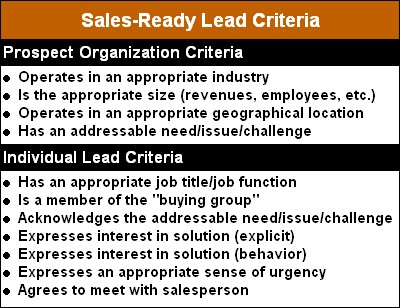
This definition provides a good starting point, but I also think it's important to use some specific criteria for identifying sales-ready leads. The table below shows eleven criteria that I suggest are appropriate for most companies. The first four criteria apply to the prospect organization, and the remaining criteria apply to the individual lead.


OK, that's how I define sales-ready lead. How about you? How would you change my definition? Would you use an entirely different approach?

Saturday, December 29, 2012

The Most Popular Posts at B2B Marketing Directions

This will be my last post for 2012, and I want to thank everyone who has spent some of his or her valuable time reading this blog. I hope that you have found the content here to be both thought-provoking and useful.

Thanks to analytics, I can see how many times each of my posts have been viewed. I thought this would be an appropriate time to share which posts have been most widely read. This ranking is based on cumulative total reads, and therefore older posts obviously have a built-in advantage.

So, in case you missed any of them, here, in order, are the four most popular posts.

Use an Importance-Performance Matrix to Get Marketing and Sales Talking - This post explains how to use an importance-performance matrix to capture the degree of agreement or disagreement between marketing and sales regarding key demand generation activities. The matrix requires marketers and salespeople to evaluate an activity along two dimensions - how important the activity is, and how well the company is performing the activity. An importance-performance matrix can reveal where significant gaps exist between marketing and sales. It won't tell you how to resolve conflicts between marketing and sales, but it will identify the issues you need to address.

Stop Depending on Your Salespeople to Generate Leads - This post explains why B2B companies should not rely primarily on their salespeople to generate new sales leads. Depending on sales reps to generate leads is a long-standing practice in many B2B companies, but changes in the attitudes and behaviors of business buyers make this practice less and less effective.

Stop Trying to Measure Marketing ROI - For the past several years, CEO's and CFO's have been demanding greater accountability from the marketing function, and they have been pressing marketers to prove the value of their activities and programs. In this environment, return on investment has become the "gold standard" for measuring marketing performance. This post explains why you can't use ROI to measure the value of every marketing activity.

It's Time to Fix the Marketing Supply Chain - Marketers are facing tremendous pressures to drive increased revenues and maximize the return produced by every dollar invested in marketing. So, it's understandable that they focus most of their attention on developing more effective marketing campaigns, creating more compelling content, and generating more sales leads. This post explains why the marketing materials supply chain represents a large, and largely untapped, source of both cost savings and revenue-enhancing improvements.

Happy New Year, everyone!


Sunday, December 23, 2012

Year-End Lessons From the Past

Early in my business career, I was privileged to have a great B2B sales mentor. I met William in 1988 and interacted with him frequently until his retirement in 1995.

William sold printing presses to commercial printing companies and businesses that had internal printing departments. The company that William worked for was (and is) highly respected within the printing industry, and William was a very successful salesperson.

Early in our relationship, William told me that one important key to his success was identifying which prospects in his territory were ready to engage in a serious evaluation process that would lead to a buying decision. William also told me that, at any given time, only about 10% of the prospects in his territory would fit this description. William realized that he could use his time more effectively and close more deals if he could consistently identify which prospects were ready to begin an "active buying cycle." So, William spent a significant amount of time "taking the pulse" of his prospects.

How did he do this? Well, he spent three or four days of almost every week visiting prospects. Sometimes, he would make appointments, but frequently, he would just drop in. In most cases, the business owner or another senior manager was willing to spend thirty minutes or an hour with William, even when he showed up unexpectedly.

During these visits, William and his prospects would discuss a range of topics - what was happening in the prospect's business and in the overall printing industry and, most importantly, any issues or problems the prospect was having with his equipment. Through these visits, William could get a pretty good idea of which prospects were ready to have a meaningful conversation about buying new equipment. When he identified these "sales-ready" prospects, William would move to a more focused selling process.

I frequently write in this blog about how B2B buyers have changed and why these changes require a new approach to demand generation. So, it would be easy for me to devote this post to a discussion of why William's approach won't work in today's environment. But, as I think about what William taught me, I'm struck more by what hasn't changed.

In 2013, as in 1990, B2B companies will need a way to determine which prospects are ready to begin a serious sales conversation . . . and which ones aren't.

In 2013, as in 1990, B2B companies will need to "stay in touch" with prospects who aren't ready to begin a serious buying process . . . because some day they probably will be ready.

In 2013, successful demand generation will be more about demonstrating value and providing prospects the information they need to make a sound buying decision than about "persuading" an unprepared or reluctant prospect to buy. And, this was largely true in 1990.

The B2B marketing and sales landscape has changed, and the new rules of B2B demand generation do require different tactics and methods. I don't believe that William's tactics will work as well today as they did in the 1980s and early 1990s, but his objectives are just as valid now as they were then.

Happy Holidays, everyone!