Sunday, April 24, 2022

[Deep Dive] An Updated Outlook for the U.S. Economy


Key Takeaways

  • The outlook for the U.S. economy for the balance of 2022 has become more uncertain than it was only a few months ago.
  • Most forecasters now expect slower economic growth, continued low unemployment and slower consumer spending and business investment.
  • High inflation and tighter monetary policy are likely to be the primary drivers of economic performance over the rest of this year.
  • How marketing leaders should adapt their planning to cope with elevated uncertainty.

Uncertainty Rises . . . Again

After enduring two years of pandemic-induced tumult, most marketers undoubtedly hoped that 2022 would provide benign and predictable business conditions. As I am writing this in April, it's clear that marketers' hope hasn't been fully realized. If anything, business conditions have recently become less predictable, and that makes the job of marketing leaders more challenging.

The success of any marketing plan depends largely on how well it fits the environmental conditions that exist when the plan is executed. One of the environmental factors that marketing leaders must consider is the state of the overall economy.

Last November when I wrote about the outlook for the U.S. economy in 2022, most forecasters were predicting that the economy would experience above-average growth, declining unemployment and relatively robust consumer spending and business investment.

Fast forward to the present, and it's clear that uncertainty about the direction of the economy over the next several months has increased sharply. Inflation has already risen to its highest level in more than 40 years, driven by continuing supply chain disruptions, the rapid increase of energy and other commodity prices, and higher labor costs. The economic sanctions imposed on Russia by the United States and many other countries in response to Russia's invasion of Ukraine will only add to inflationary pressures.

In response to the high level of inflation, the Federal Reserve raised the federal funds interest rate 0.25% at its meeting on March 15-16, and Federal Reserve Chairman Jerome Powell has indicated that this is likely to be the first of several rate increases this year.

In addition, COVID-19 hasn't disappeared, and if a new virus variant emerges that can evade vaccine-based or natural immunity, we could face another wave of disease that could depress economic activity.

These factors could have significant impacts on the performance of the economy over the rest of 2022, but it's impossible to know at this point how significant those impacts might be.

This heightened uncertainty makes in incredibly difficult to predict how economic conditions will evolve over the next several months. Under these circumstances, marketing leaders need to analyze economic conditions more frequently than usual and be prepared to adapt their marketing plans as the economic picture becomes clearer.

What's Next for the Economy?

Despite the increased level of economic uncertainty, it's possible to identify the broad economic trends that are likely to prevail over the remainder of 2022.

Economic Growth Will Slow

Most economic forecasters now expect the economy to grow at an above-average rate in 2022, although at a slower pace than in 2021. U.S. real (inflation-adjusted) GDP grew 5.7% in 2021 according to the Bureau of Economic Analysis.

Last month, U.S. Federal Reserve Board members and Federal Reserve Bank presidents predicted that real GDP will increase 2.8% in 2022 (median of individual forecasts). In their December 2021 forecast, this group had predicted real GDP growth of 4.0% this year.

Earlier this month, The Conference Board estimated that real GDP will grow 3.0% in 2022, and several Wall Street economists tracked by CNBC and Moody's Analytics are predicting real GDP growth of 3.2% this year (average of individual forecasts).

To put these forecasts in perspective, many economists believe the maximum sustainable growth rate of the U.S. economy (as measured by real GDP) is approximately 2%.

Unemployment Will Remain Low

The U.S. unemployment rate has fallen dramatically from its pandemic high of 14.7% in April 2020, and last month it stood at 3.6% according to the Bureau of Labor Statistics.

Most forecasters expect the unemployment rate to remain low throughout 2022. Federal Reserve Board members and Federal Reserve Bank presidents estimate that the average unemployment rate in the fourth quarter of this year will be 3.5%. The Conference Board's latest forecast is that the unemployment rate will fall from 3.6% in the second quarter to 3.3% in the fourth quarter of this year.

Consumer Spending Signals Are Mixed

In 2021 consumer spending ("personal consumption expenditures") increased 12.1% compared to 2020, and in February 2022, consumer spending was up 6.9% compared to February 2021, according to the Bureau of Economic Analysis

Some forecasters are predicting that consumer spending will slow significantly in 2022. Earlier this month, The Conference Board estimated that real consumer spending will increase 2.8% this year, and in March, Deloitte also predicted that it will grow by 2.8% in 2022.

Consumer spending is one of the main sources of the uncertainty surrounding the direction of the economy over the next several months. Spending by consumers typically represents about two-thirds of the total economy. Therefore, economic growth is largely dependent on the health of consumer spending.

Recent consumer sentiment data indicate that U.S. consumers have become deeply pessimistic about the state of the economy. Last month, consumer sentiment fell to its lowest level since the beginning of the COVID-19 pandemic according to the University of Michigan's Index of Consumer Sentiment.

This consumer survey data also revealed that consumers have become extremely pessimistic about future economic conditions. The "expectations" component of the Index of Consumer Sentiment fell to 54.3 last month - the most pessimistic reading in more than 10 years.

The Michigan consumer research showed that inflation concerns are primarily responsible for the high levels of consumer pessimism. The critical economic issue is whether the negative consumer sentiment will result in a major contraction in consumer spending. So far, that hasn't happened, but if it occurs, economic growth in 2022 could be substantially slower than most forecasters currently expect.

Business Investment Will Be Less Robust

In 2021, business fixed investment spending increased 7.4% according to the Bureau of Economic Analysis. Most forecasters are projecting that business investment spending will slow considerably in 2022.

Earlier this month, for example, The Conference Board estimated that "nonresidential investment" will increase 4.6% in 2022, and in March, Deloitte predicted that "real fixed business investment" will grow 3.0% this year.

Inflation Will Be High for Some Time

The future path of inflation, and the repercussions of the Federal Reserve's actions to bring inflation under control are the greatest sources of uncertainty about the performance of the economy over the balance of 2022 and into 2023.

Inflation concerns have been growing for some time, and the war in Ukraine exacerbated those concerns. The March inflation data from the Bureau of Labor Statistics confirmed that inflation is a serious economic challenge. For the 12 months ending in March, two key measures of inflation registered very high readings.

In addition, for the 12 months ending in March, average hourly earnings have increased 5.6% according to the Bureau of Labor Statistics.
As noted earlier, the Federal Reserve Open Market Committee (FOMC) raised the federal funds interest rate by 0.25% at its March meeting, and the FOMC has signaled that it is likely to raise interest rates several more times this year. 
At his press conference following the March meeting, Federal Reserve Chairman Jerome Powell said, "The economy is strong, and against the backdrop of an extremely tight labor market and high inflation, the {FOMC] anticipates that ongoing increases in the . . . federal funds rate will be appropriate."
The major uncertainty is whether the Federal Reserve will be able to engineer a "soft landing" for the economy. Can it slow the economy enough to bring inflation under control without triggering an economic recession? Many economists and financial professionals now believe the risk of recession later this year or next year has increased because of the Federal Reserve's tighter monetary policy, although most are not predicting that a recession will occur.
What Marketers Can Do
The high level of economic uncertainty that is likely to exist over the next several months makes it difficult for marketing leaders to design programs that will fit the prevailing economic and business conditions. To succeed in this uncertain environment, marketing leaders need to use a more agile approach to marketing planning. Here are three key components of an effective planning methodology.
Be Skeptical of Forecasts
Marketing leaders shouldn't place too much reliance on economic forecasts, even relatively short-term forecasts. Under normal circumstances, the forecasts discussed in this article would be reasonably accurate and stable. However, increased uncertainty makes even these forecasts less dependable.
When uncertainty is high, marketing leaders need to stay even more attuned to changes in the economic environment. The key is to frequently review economic data and look for emerging trends that may impact their company's business. Most of the official economic reports referenced in this article are published on a monthly basis, and marketing leaders must pay particular attention to these economic updates and be prepared to adjust their plans if necessary.
Assess Company-Specific Business Conditions
Changes in macroeconomic conditions don't affect all businesses equally. As we saw during the early stages of the pandemic, companies in some industries (e.g. hospitality and travel) suffered severe economic losses, while other companies (e.g. Amazon) saw their revenue and profits grow substantially.
Therefore, it's essential for marketing leaders to base their future plans on a thorough assessment of the business conditions their company is likely to be facing over the next several months. The centerpiece of this assessment should be a forecast of the revenue the company can potentially earn in the remaining quarters of 2022.
It's also critical to update these forecasts on a regular basis. More specifically, the "final" forecast for each quarter should be completed as early as possible in the preceding quarter. So, for example, marketing leaders should be focused now on developing their final revenue forecast for the third quarter of 2022, and their objective should be to finalize their forecast for the fourth quarter in July or August.
Use Quarterly Marketing Plans
In the not-too-distant past, many marketing leaders developed their plans on an annual basis. Given the current economic uncertainty, marketing leaders should plan their programs and spending in quarterly increments. By using this approach, they can better align their marketing efforts with the business conditions their company will be experiencing.
This doesn't mean that marketing leaders should develop plans from scratch for each remaining quarter of 2022. What they should do is to develop tentative plans for the final two quarters of this year based on preliminary revenue forecasts. Then, as each quarterly forecast is finalized, they can adjust their quarterly marketing plan to align with the final revenue forecast.

Image courtesy of Colin Kinner via Flickr (CC).

Sunday, April 3, 2022

[Book Review] A Strategic Guide to Using Artificial Intelligence in Marketing

Source:  Stanford University Press
The use of artificial intelligence (AI) in marketing has been discussed by an army of industry pundits, and recent research suggests that it may be nearing mainstream adoption. For example, in the seventh edition of Salesforce's State of Marketing survey (conducted May - June 2021), 60% of the respondents said they have a "fully developed" AI strategy, up from 57% in the 2020 edition of the survey.

It's easy to find e-books, white papers, and articles discussing the role of AI in marketing, and there are dozens of books dealing with the technical aspects of artificial intelligence and the social and cultural ramifications of AI.

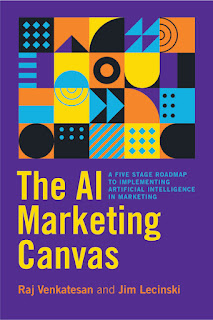
There are far fewer full-length books that provide a detailed treatment of how AI can be used to support marketing decisions and enable more productive marketing programs. For that reason, I looked forward to reading The AI Marketing Canvas:  A Five-Stage Road Map to Implementing Artificial Intelligence in Marketing (Stanford University Press, 2021).

This book was written by Raj Venkatesan, a professor of business administration at the University of Virginia's Darden Graduate School of Business Administration, and Jim Lecinski, a clinical associate professor of marketing at Northwestern University's Kellogg School of Management.

What the Book Covers

The AI Marketing Canvas includes four major sections.

Part 1 (Chapters 1-3) - This section lays out the authors' point of view on the importance of artificial intelligence in marketing and provides an overview of the book's content. Venkatesan and Lecinski state their position on AI in explicit terms at the beginning of Chapter 2. They write:

"In this new economy . . . we believe there is one way and one way only to win, and that is with AI and machine learning - developed against a rock-solid marketing strategy . . . These strategies also need to be driven by marketing leaders whose obsession is to find ways to use AI and machine learning to personalize the customer relationship at every juncture." (Emphasis in original)

Part 2 (Chapters 4-6) - Chapter 4 discusses the emergence and power of "network" business models (e.g. Amazon, Google) that are enabled by technology platforms. In Chapter 5, the authors describe their four-stage customer relationship model (acquisition - retention - growth - advocacy), and they review the three "waves" of marketing (mass-segmented marketing, data-driven marketing and one-to-one personalized marketing). Chapter 6 explains some of the basic concepts and uses of artificial intelligence and machine learning.

Part 3 (Chapters 7-13) - This part contains the core of the book's content. In Chapter 7, the authors introduce the AI marketing canvas, and then they devote a chapter chapter to a discussion of each "stage" of the canvas framework.

The AI marketing canvas is primarily a matrix created by the four customer relationship components ("moments") and a five-stage AI maturity model that includes foundation, experimentation, expansion, transformation and monetization. According to the authors, companies that achieve a high level of success with AI in marketing will move through most of these five stages of AI maturity.

Part 4 (Chapters 14-16) - The final section of The AI Marketing Canvas provides guidance for implementing the concepts discussed in the previous portions of the book. Venkatesan and Lecinski adopt John Kotter's change management model from his 1996 book Leading Change, and they argue that changes will be needed across four organizational dimensions - people, process, culture and profit - to maximize the impact of AI in marketing.

The authors conclude their book with an unambiguous "call to action" for marketers and marketing leaders. They write:  "To be a successful marketer in the coming years, you must decide now whether you will engage and become an expert in AI marketing, or sit on the sidelines and watch the 'AI bus' pass you by - or worse, run you over."

My Take

The AI Marketing Canvas is an ambitious book that, for me, doesn't quite live up to its promise. The authors expressly state that the mission of their book is to provide ". . . a road map you can use to build an effective marketing plan - one that accounts for all that is required to effectively apply AI and machine learning to your marketing - so you can win"

Rather than a detailed "road map," the book is more like an impressionist painting than a close-up photograph. It addresses most of the important issues, but it doesn't contain enough detail to be called a "how-to" manual.

That being said, The AI Marketing Canvas provides some valuable information for marketers who are novices when it comes to artificial intelligence. For example, Chapter 6 is a good introduction to AI and machine learning, but marketers will need to learn a little more to have a good working knowledge of AI and ML.

Another particularly valuable part of the book is Chapter 8, which discusses the digital infrastructure required to collect and process the customer-related data that is necessary to feed AI applications. Providers of AI-enabled software applications typically emphasize the powerful capabilities of their solutions, but they don't talk as much about the volume or quality of data that's required for those capabilities to perform as intended.

Put simply, the output produced by an AI application will only be as good or reliable as the quality of the data it uses to generate that output. In Chapter 8 of the book, the authors emphasize that building a robust data infrastructure is the first essential step in implementing AI in marketing, and that this process doesn't end. Starbucks is one of the companies featured in The AI Marketing Canvas, and the authors note that Starbucks has been developing its data collection and AI capabilities for over ten years.

Artificial intelligence is already an integral part of marketing at many larger enterprises, and the use of AI in marketing is destined to become more widespread in the near future. The AI Marketing Canvas is a worthwhile resource for marketers who are just starting to learn about artificial intelligence. If you already have a basic understanding of how AI works and how it can be used in marketing, other resources will be more useful.


Sunday, March 27, 2022

[Deep Dive] Online Marketplaces Reshape B2B Commerce and Prompt New Marketing Tactics

Source:  Shutterstock

Key Takeaways

Online B2B marketplaces are changing the landscape of business-to-business commerce. In 2019, only about 7.5% of total global online B2B sales were made via online marketplaces, but they are forecast to account for 30% of all online B2B sales by 2024.

In this article, we'll explore the shift to online B2B buying and the meteoric growth of online B2B marketplaces. We'll explain how online B2B marketplaces work, and we'll discuss what the proliferation of marketplaces means for B2B marketing.

The Rise of B2B E-Commerce

It's well documented that online B2B buying has been growing rapidly for several years. eMarketer predicts that B2B e-commerce will total $1.77 trillion this year, up from $1.58 trillion in 2021, and will reach $2.44 trillion in 2025. In 2020, B2B e-commerce sales in the US represented only 14% of total US B2B sales, so B2B e-commerce has plenty of room to grow.

The growth of B2B e-commerce is due to several factors. Because of the popularity of consumer-oriented e-commerce sites, most business buyers are accustomed to making online purchases in their personal lives, and many have become comfortable with making business purchases online.

A generational "changing of the guard" in B2B buying is also boosting the growth of B2B e-commerce. In a 2020 survey of 17,000 business professionals by The B2B Institute and GWI, 40% or more of the millennial respondents (ages 21-40) said they have influence at every stage of the buying process used in their company. Millennial business buyers have been using digital technologies for most of their lives, and they are particularly comfortable using e-commerce for business purchases.

The COVID-19 pandemic accelerated the shift to online buying by consumers and business buyers. In the November 2021 edition of McKinsey's B2B Pulse Survey, 32% of the respondents ranked e-commerce as their company's most effective selling channel, up from 22% in the February 2021 survey. For the first time, e-commerce ranked higher than in-person as the most effective selling channel.

Clearly, e-commerce is already a major feature of the go-to-market operations of many B2B companies, and it's likely to become even more important in the future. As a result, e-commerce has become a hot topic among B2B company leaders, and it's been widely discussed in the business literature.

However, online B2B marketplaces have received considerably less attention, particularly in B2B marketing circles. Because of their popularity with business buyers, online marketplaces are likely to become a significant selling channel for many B2B companies. So, it's important that B2B marketers understand how they work and how to market effectively to marketplace buyers.

The Basics of Online B2B Marketplaces

Source:  Public Domain

An online B2B marketplace is an e-commerce environment where multiple vendors offer products or services to business customers. The distinguishing characteristic of an online marketplace is the role played by the marketplace operator. In a "pure" marketplace, the operator provides the e-commerce capabilities that enable transactions between buyers and sellers but doesn't sell its products or services in the marketplace.

Of course, many marketplace businesses are not "pure" marketplaces by this definition. For example, Amazon's consumer business is a "hybrid" because the company:

  • Sells Amazon-branded products (e.g. "Amazon Basics")
  • Purchases products from other companies and resells those products, thus acting like a conventional retailer
  • Provides a marketplace that enables third-party vendors to sell on the Amazon platform
Marketplace operators can earn revenue in a variety of ways, such as by:
  • Charging sellers or buyers, or both, a fee to join the marketplace
  • Charging a transaction fee for each sale made in the marketplace
  • Providing fulfillment services (e.g. "Fulfillment By Amazon"}
  • Selling advertising on the marketplace site
B2B Marketplaces Are Growing Rapidly
Online B2B marketplaces are a relatively new feature of the B2B commerce landscape, but the number of marketplaces has been rapidly increasing. Last year, Digital Commerce 360 listed 250 "leading" marketplaces, and that list isn't comprehensive.
The volume of business conducted on B2B marketplaces is also growing rapidly. Digital Commerce 360 recently predicted that sales on B2B marketplaces grew 130% in 2021 and totaled $56.0 billion. The firm also estimated that in 2021, B2B marketplace sales grew 7.3 times faster than overall B2B e-commerce sales and 8.5 times faster than total manufacturer and distributor sales.
B2B marketplaces are growing because they are increasingly popular with business buyers. According to Statista, about a third (34%) of global B2B buyers surveyed last September said they made 50% or more of their business purchases on marketplaces.
The Two "Flavors" of B2B Marketplaces
Online B2B marketplaces are classified as horizontal or vertical. A horizontal marketplace will typically offer a wide assortment of products or services that can be used by many types of businesses. Amazon Business and Alibaba are good examples of horizontal B2B marketplaces.
In contrast, vertical B2B marketplaces are designed for buyers working in specific industry verticals, and they offer products or services that are primarily used in those industries. Farmers Business Network (agricultural products used by farmers), ChemNet (agricultural and industrial chemicals) and GoDirect Trade (aviation products) are good examples of vertical B2B marketplaces.
How Marketplaces Benefit Buyers
B2B marketplaces can provide business buyers and their companies several valuable benefits.
Easy supplier discovery - A marketplace makes it easy for business buyers to discover new suppliers.
Greater choice - By including products and services from multiple suppliers, marketplaces offer business buyers a wider assortment of goods and services than they can typically find with a single vendor.
Lower cost - When a marketplace focuses on standard products or services, it will typically include product/service pricing. This pricing information is visible to both buyers and sellers, and the price transparency can increase competition among sellers, which often results in lower prices for buying organizations.
One-stop shopping - A marketplace can enable business buyers to purchase multiple products or services across a range of categories in a single transaction, which can reduce the time buyers must spend finding and buying the products or services they need.
Reduced supplier management - Buying through a marketplace can significantly reduce the number of suppliers a buying organization must onboard and manage. Buyers are able to deal only with the marketplace for most purchase-related issues rather than dealing with multiple suppliers.
Marketplaces Help "Tame the Tail"
In addition to the specific benefits discussed above, online B2B marketplaces can help B2B companies address a larger business issue - how to better manage their "tail spend."
External purchases in most companies have a Pareto-like distribution. The largest 20% of outside suppliers (by dollar volume) typically account for about 80% of the total external spend, while the remaining 20% (or so) of spend is spread across the smallest 80% of suppliers. Sourcing and procurement professionals call this 20% "tail spend."
Tail spend is difficult to manage using conventional procurement practices because it involves a large volume of relatively low-value purchases made from many suppliers. Therefore, tail spend is not "professionally managed" in many companies, and the result can be overspending and missed opportunities for cost savings.
By using one or more B2B marketplaces for these types of purchases, companies can gain greater visibility of their tail spend. B2B marketplaces typically provide buying organizations detailed data regarding their purchases in the marketplace, and some marketplaces enable buying organizations to control the purchases made by their individual buyers.
For example, Amazon Business enables companies that enroll in the Amazon Business Prime program to designate some vendors or products as "Preferred" and others as "Restricted." Large enterprises can also completely block buyers from purchasing certain products.
How Marketplaces Benefit Sellers
The benefits of online B2B marketplaces for buying organizations and individual buyers are clear. But B2B marketplaces can also provide valuable benefits to selling companies.
One of the most important benefits is expanded reach. By joining a marketplace, selling companies gain exposure to a large pool of potential customers, some of which they would not have otherwise reached. For example, a marketplace will often provide exposure to potential customers located outside a seller's current geographic market area.
A B2B marketplace may also enable a company to sell to customers that the company cannot profitably serve through its existing sales/distribution channels. For example, the systems and processes used by some B2B companies make it difficult for them to earn a reasonable profit on "small" sales. The technologies and services offered by B2B marketplaces can make such sales profitable. Therefore, by joining a B2B marketplace, a company may gain the ability to serve new customer segments.
Implications for Marketing
Source:  Limelight Leads
As B2B marketplaces become increasingly popular with business buyers, more B2B companies are likely to make marketplace selling an integral part of their go-to-market strategy. The issue for marketers in such companies is whether successful marketplace selling will require some new marketing techniques.
Most B2B marketing techniques and practices are designed for "high consideration" purchases that involve expensive and/or complex products or services, multiple decision makers and long buying cycles. But high consideration purchases have never represented all or even most B2B commerce, and most purchases made on B2B marketplaces don't fit the high consideration stereotype.
Therefore, to drive sales via marketplaces, marketers will need to use a different approach to marketing. More specifically, they need to think like marketers at a consumer packaged goods company and focus on two areas that don't receive much attention in B2B marketing - brand building and merchandising.
Build Brand Awareness and Mental Availability
In a marketplace environment, when a buyer searches for a particular type of product, the marketplace software will likely display multiple options from multiple sellers. Under these circumstances, brand awareness/familiarity and mental availability will greatly influence the buyer's purchase decision.
Brand awareness is self-explanatory, but the concept of mental availability may be less familiar to some B2B marketers. Mental availability refers to the likelihood that a particular brand or company will come into the mind of a buyer when he or she is in a buying situation. When a brand or a company achieves a high level of mental availability with potential buyers, the odds of winning sales increase substantially.
Many of the advertising and marketing programs run by CPG marketers are designed to increase brand awareness and mental availability, and B2B marketers need to focus more attention on these objectives to drive marketplace sales.
Focus on Effective Merchandising
Successful selling on a B2B marketplace also requires good merchandising. Merchandising is usually associated with brick-and-mortar retailing. It encompasses things like store design, layout and decoration, product display and product packaging. The goal of merchandising is to create an in-store experience that will entice shoppers to buy.
When selling via an e-commerce channel - including a marketplace - the website is the "store" and merchandising is mostly about the functionality of the e-commerce platform and the content the website contains.
In a marketplace setting, the marketplace operator obviously controls the functionality of the e-commerce platform and also exercises some control over what types of product information can be used and how that information can be displayed.
However, individual sellers in a marketplace also have some control over the quality and completeness of the information appearing on their product pages. Therefore, B2B marketers need to make their product pages as appealing as possible to marketplace buyers.
For example, marketers should use high-quality product images and possibly include videos if they're allowed by the marketplace platform. Marketers should also focus on providing product information that is tailored to meet the needs and expectations of the types of buyers who are most likely to be using the marketplace.
As with merchandising in the brick-and-mortar world, the objective of merchandising in a marketplace setting is to create a shopping experience that will encourage business shoppers to buy.
Final Thoughts
Online B2B marketplaces are poised to become an important selling channel for a significant number of B2B companies. The volume of business conducted on marketplaces is growing because they provide business buyers a convenient, user-friendly and efficient way to find and buy a wide range of products and services.
They also benefit buying organizations by providing an effective way to gain greater visibility and control of external spending that is difficult and costly to manage using conventional sourcing and procurement methods.
These benefits will lead a growing number of business buyers and their companies to gravitate to online B2B marketplaces, and B2B suppliers must be prepared to sell on marketplaces if they want to be where their potential customers are.

Sunday, March 20, 2022

Why Brand Loyalty Is a Rare Commodity


Most B2B companies derive the majority of their revenue from continuing sales to existing customers. So it shouldn't be surprising that customer retention is an important business priority. Many companies are making substantial investments to improve the customer experiences they provide in the hope of enticing their customers to remain loyal.

Unfortunately, it appears that customer loyalty is more elusive than ever. Marketing and customer experience pundits have been proclaiming the demise of customer loyalty for the past several years, and two recent surveys lend support to their point of view.

Earlier this year, Edit and Kin + Carta published the results of a survey of 2,000 consumers in the US and the UK. Over a quarter of the survey respondents (27.4%) said they have no brand loyalty in any industry sector.

In this survey, a nearly equal percentage of men and women (28%/27%) reported having no brand loyalty, but there sere significant differences across generational cohorts. Somewhat surprisingly, Gen Z and millennials were less likely to report no brand loyalty (18% and 28% respectively) than Gen X and baby boomer respondents (34% and 39% respectively).

Research last year by Wunderman Thompson Commerce (a WPP agency) showed that low levels of customer loyalty aren't limited to consumers. The B2B Future Shopper Report 2021 was based on a survey of 604 B2B buyers in the US (202), the UK (201) and China (201).

Remarkably, 55% of the US-based respondents said they had switched suppliers for all business purchases in the 12 months preceding the survey. Another 41% said they had switched suppliers for some business purchases over the same time period. In the 2020 edition of the survey, the comparable percentages were 20% for all purchases and 43% for some purchases.

Why Has Customer Loyalty Declined?

Declining customer loyalty is not a new phenomenon, but a combination of factors have caused the pace of decline to accelerate in recent years.

For example, the abundance of online information enables customers to easily discover and learn about new products, services and suppliers. Pricing information is also widely available, which makes it easy for customers to comparison shop for the best available deal.

This widespread availability of information can reduce some of the risks that are usually associated with buying a product or service - or buying from a supplier - the customer isn't familiar with. In other words, easy access to information lowers the fear and uncertainty that often comes with trying a new product or supplier.

Customer expectations for convenient and frictionless experiences have also risen, and many companies haven't kept pace with these changing expectations. Keeping up is particularly challenging because customers tend to compare the experiences your company provides to the best experiences they've enjoyed with companies of any type. Therefore, your company is always competing against the "best-of-breed" customer experiences provided by all types of businesses.

The COVID-19 pandemic has also contributed to the decline of customer loyalty. During the pandemic, many consumers and business buyers were forced to adopt new shopping and buying behaviors, and in some cases, to change product/service brands or suppliers. Once customers have had good experiences with these new behaviors, products, services and suppliers, they become more willing to "shop around" in the future.

Time to Reset Expectations

In today's information-rich and competitive business environment, where customers are easily enticed to engage in promiscuous buying behaviors, company leaders need to reset their expectations relating to customer loyalty.

First of all, as marketing and business leaders, we need to recognize that exclusive brand/company loyalty by customers - at least over an extended period of time - is an unrealistic aspiration.

Raja Rajamannar, the Chief Marketing and Communications Officer of Mastercard, addressed this issue in his book, Quantum Marketing:  Mastering the New Marketing Mindset for Tomorrow's Consumers (which I reviewed last month in this post). After citing statistics showing that 75% of men and 68% of women have admitted to cheating in some way, at some time in a relationship, he writes:

" . . . if people are not loyal in their committed relationships, are we as marketers and businesspeople realistic in expecting loyalty from our consumers? If they are not loyal in their personal lives, are we fantasizing that we will generate their loyalty to our brands? We are, after all, way down the food chain of attention, as far as people's lives are concerned."

The second necessary aspect of the reset is to recognize that customer loyalty is a fragile phenomenon that requires frequent reinforcement. In this sense, customer loyalty is a little like COVID-19 vaccines. The mRNA vaccines used here in the US are highly effective, but the protection against infection isn't exceptionally durable. As we now know, that protection begins to wane rather quickly. As a result, one "booster" dose has already been recommended, and my personal default assumption is that I'll be lining up for another "jab" sometime in the next few months.

Because customer loyalty is no longer very durable, it requires frequent "boosting" to maintain its potency. In fact, marketing and business leaders should view every interaction with a customer as an opportunity to re-energize that customer's loyalty and commitment.

To be clear, customer loyalty isn't likely to regain the durability it had 30 or 40 years ago, but it can still be a potent competitive advantage if companies focus on consistently delivering outstanding customer experiences.

Image courtesy of One Way Stock via Flickr (CC).

Sunday, March 13, 2022

[Research Round-Up] ABM, Marketing Spending and Next Generation Events

 (This month's Research Round-Up features the latest ABM benchmark study by ITSMA and the ABM Leadership Alliance, Winterberry Group's latest forecast of marketing and advertising spending, and a survey examining the future of marketing events by the CMO Council and Cvent.)

Embedding ABM:  Next Steps for Market Leadership (2021 ABM Benchmark Study) by ITSMA and the ABM Leadership Alliance


Source:  ITSMA/ABM Leadership Alliance

  • An online survey of marketers with ITSMA member companies and ABM Leadership Alliance contacts
  • 313 respondents (91% affiliated with technology, finance and business services companies)
  • 70% of respondents from North America and the Caribbean
  • 24 interviews with leading ABM practitioners
  • Survey fielded in August 2021 - report published in December 2021
This is the fifth annual ABM benchmark study by ITSMA and the ABM Leadership Alliance, and it includes several findings about the state of ABM in 2021.
For example, the research found that, on average, survey respondents were devoting 27% of their 2021 marketing budget to ABM, and 75% of the respondents expected their ABM budget to increase this year. Seventy-two percent reported that ABM delivers higher ROI than other types of marketing.
The latest survey also provides important insights about the attributes and practices of companies with high-performing ABM programs. The researchers divided the survey respondents into two cohorts - ABM Leaders and All Others. ABM Leaders were defined as the respondents who indicated their ABM efforts had produced a significant improvement in business results. By this definition, 33% of the survey respondents were classified as ABM Leaders.
The survey results showed that ABM Leaders:
  • Have broader objectives and greater stakeholder alignment (particularly with sales)
  • Are more proficient across a wide range of skills
  • Invest more in tools, templates and processes that enable knowledge/best practices sharing
  • Are more likely to be using data and analytics technologies
  • Are more likely to be using ABM-related technologies to their full potential
If you're involved in account-based marketing, this research will be a valuable resource.

Source:  Winterberry Group
  • Spending estimates and forecasts for twenty media/marketing channels
  • A review of trends that will shape the U.S. marketing and advertising industry in 2022
  • Report published in January 2022
This report includes estimates of marketing and advertising spending in the United States for 2021 and 2022. It covers twenty media/marketing channels - nine offline channels (e.g. linear TV, direct mail) and eleven online channels (e.g. display advertising, digital video).
Winterberry's estimates are similar to the projections made by other forecasters, including most of the major advertising agencies. The firm estimates that U.S. marketing and advertising spending rebounded sharply in 2021 and will increase again in 2022. More specifically, Winterberry projects that spending on online channels will increase 16.6% this year, while spending on offline channels will grow 5.9%.
Among online channels, Winterberry predicts that influencer marketing will experience the greatest percentage increase in spending this year - 51.3%. Among offline channels, the firm expects addressable TV to garner the greatest spending increase - 27.4%.
Aligning Strategy, Teams and Tech for Success in the New Era of Events by the CMO Council (in partnership with Cvent)

Source:  CMO Council
  • A survey of 150 global marketing leaders
  • In-depth interviews with executives from Equifax, GE Healthcare, HCL Software and GfK
  • Report published in February 2022
The COVID-19 pandemic decimated in-person conferences, trade shows and other marketing events for the better part of two years. In 2020, marketers and event sponsors and planners pivoted quickly to make many of their events virtual. Many marketers are now hoping for a return to normalcy in 2022, and they are thinking about what the future of events will look like.
This report by the CMO Council (in partnership with Cvent) provides several important insights about how marketers are thinking about the "new era" of events, and how what they learned during the pandemic will affect future event strategies.
Here are a few of the headline findings:
  • Sixty percent of the survey respondents said restarting in-person events is very important or critical, but the same percentage of respondents expect future in-person/hybrid events to be smaller than pre-pandemic in-person events.
  • Forty-four percent of the respondents said webinars and virtual events have slowed down but still deliver good value, and 20% said such events continue to deliver tremendous reach for their content.
  • Sixty-four percent of the respondents said they are not effective or only moderately effective and executing virtual events that deliver value to their organization.
When asked about how what they learned during the pandemic will change event management strategies, 65% of the respondents said that all types of events will be better aligned to specific marketing outcomes.

Sunday, March 6, 2022

[Book Review] Tools for Building Powerful Brands

Source:  Amazon

B2B marketers are under constant pressure to drive revenue growth, and a growing number of B2B marketers now recognize that a powerful brand will make it easier to achieve revenue growth objectives.

But building a strong brand is challenging because it requires marketers to possess and use a diverse set of skills, including the development of deep market and customer insights, analytical thinking and creativity.

In Positioning for Advantage:  Techniques and Strategies to Grow Brand Value, Kimberly A. Whitler, the Frank M. Sands Sr. Associate Professor of Business Administration at the University of Virginia's Darden School of Business, provides a set of pragmatic methods (which she calls "tools") that marketers can use to create and sustain high-performing brands. 

Before teaching, Whitler spent nearly 20 years in general management, strategy and marketing roles at several consumer products and retail companies, including Proctor & Gamble, David's Bridal and PetSmart.

Tools to Fill the "Theory-Doing Gap"

In the introduction to Positioning for Advantage, Whitler writes that the fundamental job of marketers is to "create businesses - through brands - that win in the marketplace." The problem, she observes, is that "the marketing curriculum in schools is largely theory based, with little insight into the tools that marketers can employ to create brand advantage." 

Whitler argues that this creates a "theory-doing gap," and she says that Positioning for Advantage is designed to fill that gap by providing a set of tools for "aspiring C-level marketers."

Whitler discusses eight tools in Positioning for Advantage, which she places in three categories.

  • Marketing strategy tools
    • The positioning concept (Chapter 2)
    • The brand essence statement (Chapter 3)
    • Strategy maps (Chapter 4)
  • Bridging tools
    • The strategic marketing plan (Chapter 5)
    • The creative brief (Chapter 6)
  • Planning tools
    • The marketing technology blueprint (Chapter 7)
    • Key opinion leader and influencer maps (Chapter 8)
    • Brand measurement tools (Chapter 9)
The Power of Positioning
As the title suggests, Positioning for Advantage asserts that marketers create competitive advantage for their company through their decisions and actions regarding brand positioning. Whitler writes:
"Specifically, marketers create advantage by combining the firm's resources with insight-generating market intelligence (e.g. competitors and consumers) and direction from firm-level strategies in order to make strategic marketing choices about where the brand should play . . . The result leads to a 'desired positional advantage,' or the potential to occupy a place in the hearts and minds of the target consumers that gives the company the ability to achieve superior market share outcomes."
Once marketers have defined the brand positioning, their job becomes to develop and implement marketing activities and programs that will enable the brand positioning to be achieved.
All of the tools discussed in Positioning for Advantage are valuable, but two stand out in importance - the positioning concept and the brand essence statement.
The Positioning Concept
A positioning concept is a tool that marketing leaders use to summarize why a brand (or a product or service) exists. It usually contains three major components.
  1. Problem Statement -  A statement of the problem potential buyers are experiencing that the product or service will solve. It is written in the first person from the perspective of a potential buyer.
  2. Solution Statement - A statement describing how the product or service will solve the problem identified in the problem statement.
  3. Proof (Solution) Statements - Statements describing the proof the company will offer to demonstrate that the "promise" made in the solution statement will be kept.
Whitler argues that marketers should create several versions of these statements and test them with potential buyers to identify the version of each statement that is most appealing.
The Brand Essence Statement
Positioning for Advantage describes the brand essence statement (BES) as follows:
"A BES is a document, picture, video, or some other communication vehicle that captures . . . the intrinsic nature and indispensable quality that makes a brand unique, compelling, and meaningful to a target. It is essentially a blueprint that defines the pieces and parts of the brand and provides a guide against which to implement the brand."
The format of brand essence statements can vary, but most will include four key components.
  1. A foundation that describes the brand's values and personality
  2. A description of the rational and emotional benefits the brand will provide to the customer (the impact component)
  3. The proof that the brand will deliver on the rational benefits that are promised
  4. A summary statement of what the brand can do for the target customer (the brand essence)
Is Positioning for Advantage Useful for B2B Marketers?
Some readers may be questioning how useful Positioning for Advantage will be for B2B marketers. It's true that the book is written primarily from a B2C perspective. Professor Whitler writes that consumer package goods companies and retailers have the most advanced marketing capabilities, and most of the examples used in the book involve consumer products or services.
It's also true that some of the tools described in the book will need to be adapted to work well in B2B. For example, B2B companies that offer expensive and/or complex products or services must usually market to buying groups composed of several individuals whose perspectives and priorities can differ. Therefore, marketing leaders at such companies may need to develop a distinct positioning concept for each type of buyer in the buying group.
Even with these caveats, Positioning for Advantage is a valuable resource for B2B marketers. In my experience, brand positioning is not emphasized enough in the marketing planning process at most B2B companies. The customer-centric, market-centric approach to brand positioning described by Kimberly Whitler will help B2B marketers build powerful brands that will drive revenue growth.

Sunday, February 27, 2022

[Deep Dive] For Better Marketing Measurement - Draw a Map


Image Source:  Shutterstock

Key Takeaways

Marketing leaders are facing constant demands to improve marketing performance and prove the business value of marketing activities. To meet these demands, marketing leaders need an effective marketing measurement system, but measuring marketing performance has been a perplexing challenge for decades, and it remains a significant issue today.

In this article, we'll explain - 

  • Why the key to building a robust marketing measurement system is to tie the system to your marketing strategy
  • How to use a marketing strategy map to describe your strategy in measurable terms and link your marketing activities to business value
Marketing Measurement is Still a Challenge
The persistent and growing demands for greater accountability from marketing has resulted in a huge volume of literature describing how to measure marketing performance. Marketing industry pundits have addressed the topic from almost every conceivable angle in dozens of ebooks, white papers, articles and presentations.
Despite all this attention, recent research indicates that many marketers aren't satisfied with their marketing performance measurement system. In the 2021 Marketing Measurement & Attribution Survey by Demand Gen Report, 58% of B2B marketing executives said their company's ability to measure and analyze marketing performance is poor/inadequate or needs improvement.
Marketers attribute their dissatisfaction to a variety of specific factors, including data and technology issues. But it's increasingly apparent that many marketers need to take a fresh look at how they're approaching the task of measuring marketing's performance and value.
The Key to Meaningful Marketing Measurement
The key to building an effective marketing measurement system is to tie the system directly to the company's marketing strategy. In other words, the measurement system should be designed to measure how well the marketing strategy is working. That's because the performance of marketing and its ability to add value to the business are largely dependent on the quality and execution of the marketing strategy.
Deriving marketing metrics from marketing strategy is also the right approach because a company's marketing strategy is ultimately defined by what marketing activities it chooses to perform, how it chooses to perform those activities, and how those activities relate to and reinforce one another. Therefore, marketing activities are the building blocks of marketing strategy, and marketing strategy is the essential connective tissue that links marketing activities to business value.
This approach has several implications for marketing leaders. Most importantly, it means they will need to describe their marketing strategy in measurable terms before they select specific marketing metrics.
The Architecture of a Marketing Strategy Map
The best tool for describing a company's marketing strategy in measurable terms is a marketing strategy map. A strategy map is simply a diagram that depicts the marketing objectives and activities that constitute the major elements of a company's marketing strategy.
These objectives and activities are arranged in a hierarchy of linked cause-and-effect relationships. A marketing strategy map makes these relationships and dependencies visible, and therefore it will enable marketing leaders to measure how well their strategy is working.
In this post, I'll describe the basic architecture of a marketing strategy map. Every company's strategy map will be unique because every company's marketing strategy is unique. In this discussion, I'll cover components that appear in most marketing strategy maps, and I'll use others for illustrative purposes.
To keep the length of this post manageable, my discussion will focus on a vertical "slice" of a complete marketing strategy map. This will allow me to describe the full "depth" of a strategy map and demonstrate how it enables marketing leaders to connect marketing activities to strategic business outcomes.
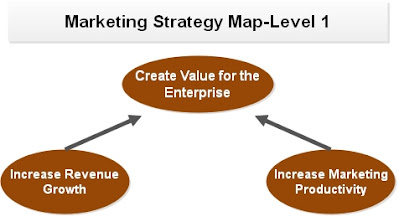
The most effective way to build a marketing strategy map is to use a top-down approach. In virtually all companies, the ultimate goal of marketing is to create value for the enterprise, so that objective is placed at the top of the strategy map, as shown in the following diagram.


Marketing can create value for the enterprise in two basic ways - by driving revenue growth and by increasing the productivity of the marketing function. A sound marketing strategy will seek to create value in both ways. Therefore, most marketing strategy maps will include both a revenue growth objective and a marketing productivity objective, as the diagram shows.
A marketing strategy map also makes the "logic" of the strategy clear. In the above diagram, the directional arrows indicate that the hypothesis of the strategy is that marketing will create value for the enterprise if it drives revenue growth and improves marketing productivity.
Most marketers will use return on marketing investment to measure marketing's contribution to the value of the enterprise. Revenue growth is often measured using the year-over-year percentage growth rate. Marketing productivity can be measured in several ways, but one of the better metrics is the revenue turnover ratio. This ratio is calculated by dividing total annual revenue by total annual marketing costs.
The balance of this post will focus on the revenue growth side of a marketing strategy map, part of which is depicted in the following diagram.


Virtually all companies have access to four structural sources of organic revenue growth.
  1. Continuing sales to existing customers (customer retention)
  2. Increased sales to existing customers
  3. Sales to new customers in existing markets
  4. Sales to new customers in new markets
The marketing strategies of most companies will include objectives for most, if not all, of these sources of revenue growth, as the above diagram illustrates.
Marketers can use a variety of metrics to measure their success at achieving these revenue growth objectives. For example:
  • For continuing sales to existing customers - annual customer churn rate
  • For increased sales to existing customers - share of wallet (in the relevant category)
  • For sales to new customers in existing markets - 
    • Number of new customers acquired in existing markets
    • Revenue from new customers acquired in existing markets
  • For sales to new customers in new markets - 
    • Number of new customers acquired in new markets
    • Revenue from new customers acquired in new markets
Once again, a marketing strategy map uses directional arrows to make the logic of the marketing strategy clear. If marketing successfully drives revenue from a combination of these growth sources, it will achieve its overall revenue growth objective.
It's important to make three points concerning the four revenue growth objectives shown above. First, some marketing leaders will use more specific versions of these growth objectives if their marketing strategy is more targeted. For example, if company leaders believe that acquiring new customers in certain industry sectors is an attractive growth opportunity, marketing leaders may use objectives and metrics that are specific to those industry sectors.
Second, marketing leaders will place different priorities on these four growth objectives based on the market and competitive conditions their company is facing. And third, some marketing leaders may not use all four growth objectives. For example, some companies may have no current plans to enter a new market.
The marketing objectives I've discussed so far would be appropriate for most companies. The remaining objectives will be more company specific because they are dependent on what a company sells, the attributes of the buying process used by the company's prospects and customers, and the specific marketing tactics the company plans to use.
The following diagram shows an illustrative set of marketing objectives that relate specifically to one of the growth objectives previously discussed - acquiring new customers in existing markets.


The marketing strategy depicted in this diagram is focused on three objectives - increasing brand awareness, increasing the level of buyer engagement, and increasing the number of qualified sales opportunities. The logic of this strategy can be described as follows:
  • Increasing brand awareness will result in an increased level of buyer engagement with the company.
  • Increasing buyer engagement will increase the number of qualified sales opportunities available to the company.
  • Increasing the number of sales opportunities will increase the number of new customers the company acquires and increase revenue from new customers
The final component of a marketing strategy map is a description of the types of activities marketing leaders will implement to achieve the identified objectives. Each marketing activity is linked to the objective or objectives marketing leaders believe the activity will impact.
For this discussion, I'm using one marketing activity - blogging - to illustrate how to address marketing activities in a strategy map. In the above diagram, blogging is designed to increase brand awareness and to increase buyer engagement. The logic of marketing leaders would be:  If we increase the quantity and quality of the content published at our blog, we will increase the awareness of our company and/or brand by potential buyers, and we will also increase engagement by potential buyers.
Marketers can use several metrics to measure brand awareness and buyer engagement. Some examples are:
  • For brand awareness - 
    • Share of search
    • Brand health surveys
  • For buyer engagement  - 
    • Number of website visitors
    • Number of content views/downloads
    • Time spent with website content
Marketers also have several options for measuring the specific performance of their blog. These could include number of pageviews and shares of blog content on social media.
Of course, marketing leaders will implement other types of marketing programs to drive increased brand awareness and increased buyer engagement. A complete marketing strategy map will include all of the types of marketing activities that are part of the marketing strategy, and those activities will be linked to one or more marketing objectives.
The Most Important Benefit of a Marketing Strategy Map
A marketing strategy map provides several benefits, but the greatest benefit is that it helps marketing leaders solve one of the most difficult challenges associated with marketing performance measurement.
 Marketing creates business value through activities that operate at different stages of the value creation process. The problem is, many marketing activities contribute to business value only indirectly, and some will be several steps removed from the economic outcomes they affect. Under these circumstances, it's difficult for marketing leaders to show the financial value of such "remote" marketing activities.
When marketing leaders build a strategy map, they create a chain of linked marketing activities and objectives that makes it possible to connect marketing programs to top-level business outcomes in measurable ways.
The following diagram illustrates how a marketing strategy map can be used to prove the value of a "remote" marketing activity, in this case blogging.


It would be very difficult to prove that blogging has an impact on enterprise value because the direct relationship (the correlation) between blogging activity and changes in business value is weak. The diagram uses a thin dotted line to depict this weak relationship.
However, the marketing strategy described in this post is based on the hypothesis that publishing a high-quality blog will increase brand awareness and buyer engagement. The relationships between blogging activity and both increased brand awareness and increased buyer engagement are direct and can be measured. So, if the hypothesis of the strategy is valid, improving the quality of blog content will result in greater brand awareness and buyer engagement.
The marketing strategy depicted in the diagram is also based on the hypothesis that increasing brand awareness and buyer engagement will result in more sales opportunities, which will result in more sales to new customers, which will lead to overall revenue growth. And revenue growth will create value for the enterprise.
The relationships among the adjacent marketing objectives shown in the above diagram can all be measured quantitatively, which enables the hypothesis of the strategy to be tested and validated.
The bottom line is, the chain of linked marketing activities and objectives in a marketing strategy map enables marketing leaders to test the effectiveness of their marketing strategy and to demonstrate the indirect impact of marketing activities on business outcomes and value.