Showing posts with label Relevance. Show all posts

Sunday, February 4, 2024

Leverage Buyer Goals to Drive Breakthrough Marketing Results

Source:  Shutterstock

I've always been skeptical of claims that using any one technique or tactic will consistently result in superior marketing performance. Simple, "silver bullet" solutions for big, complex challenges are incredibly rare in the real world.

But, if there is one key to decoding the formula for effective marketing, it is the ability to understand how people make decisions and what drives human behavior.

Understanding what will cause a potential buyer to respond to your marketing messages and ultimately buy your product or service is a prerequisite for developing an effective marketing strategy and creating persuasive marketing messages and content.

When you can't identify the factors that underlie human decision-making and behavior, it's nearly impossible to design marketing programs that are consistently successful. It's like trying to navigate by the stars on a cloudy night. 

The good news is, you can use established principles of decision science to identify and better understand the mechanisms that drive your potential buyers' decision-making and behavior.

The Critical Role of Buyer Goals

Recent advances in decision science have established that motivation is the primary driver behind all human behavior, including buying behavior.

The American Psychological Association defines motivation as, "a person's willingness to exert physical or mental effort in pursuit of a goal or outcome." Put another way, motivation is the willingness to take action to achieve a goal. The goal may be to solve a problem, satisfy a need, or get a particular "job" done.

As humans, we pursue a goal because we expect to receive a reward if the goal is achieved. Neuroscience has shown that the human brain has a "reward system," which is a group of structures and neural pathways that are activated when our brain processes sensory inputs that signal a reward we value.

When our brain's reward system is activated, we are motivated to pursue the goal that will enable us to reap the expected reward. And the more we value the expected reward, the more motivated we become to achieve the goal.

Our goals also largely dictate what we pay attention to. Research has shown that our brain automatically scans our environment for information that aligns with our goals. So, in essence, our brain causes us to pay attention to information that is closely related to our goals.

Lastly, goals can be explicit or implicit. Explicit goals are those we set and pursue at a conscious level. An implicit goal operates primarily at a subconscious level. These goals arise out of basic human physical, psychological, and social needs, things like safety, security, and autonomy. We are motivated to pursue implicit goals even when we aren't consciously thinking about them.

Implications for Marketers

These principles of decision science have major implications for marketers. The most important lesson is that the ability of any marketing message to provoke a response from a potential buyer is determined by how closely the message aligns with the buyer's goals. That degree of "fit" is what makes the message relevant to the buyer and what will prompt him or her to respond.

This means you need to identify what the goals of your potential buyers are and then craft messages that are linked to those goals. Unfortunately, this is easier said than done for two main reasons.

First, buyer goals are highly individualistic. They can differ even among buyers who have similar demographic attributes, work in similar types of businesses, and have similar job titles and functions. Therefore, even well-constructed buyer personas may not reveal what goals are most important for an individual buyer.

Second, the goals of a business buyer can and will change as the opportunities and challenges facing the buyer's organization change. This means that a buyer who doesn't respond to a particular marketing message today might well respond to the same message received a month from now.

The challenges presented by these two factors are always present, but they are more pronounced when you're seeking to acquire new customers.

If you are properly nurturing your relationship with an existing customer, you should be well-positioned to understand what your customer's high-priority opportunities and challenges are at any point in time. And that gives you greater insight into the goals your customer's buyers are likely to have.

When you're seeking to acquire new customers, the most effective strategy is to ensure that your marketing messages feature links to one or more of the implicit goals I discussed earlier. This approach has two main advantages.

First, implicit goals are universal because they arise out of fundamental psychological and social needs that all humans share. And second, implicit goals are durable; they don't change much over time. Therefore, marketing messages linked to these goals will likely resonate with most of your buyers whenever they are used.

The bottom line is:  If you want to achieve consistent marketing success, there's no substitute for understanding your buyer's goals.

Sunday, June 26, 2022

How Marketers Can Leverage Job-Focused Content . . . and Why They Should


The first step in designing an effective marketing strategy and creating compelling content is to understand what potential buyers are trying to accomplish when they purchase particular products or services. In most cases, people don't buy a product or service primarily because they want the product or service itself. Most often, what they really want is what the product or service will help them accomplish.

Theodore Levitt, the legendary professor of marketing at the Harvard Business School, expressed this truth when he often reminded his students that, "People don't want to buy a quarter-inch drill. They want a quarter-inch hole."

In The Innovator's Solution, Clayton Christensen and co-author Michael Raynor built on Professor Levitt's insight and described what is called the jobs-to-be-done framework. Christensen acknowledged that he did not originate the jobs-to-be-done framework, but his adoption of the model has helped make it part of mainstream business and marketing thinking.

The basic idea of this framework is that when people become aware of a "job" they need to get done, they look for a product or service they can "hire" to perform the job.

Christensen argued that this is how potential customers "experience life." Their thought process begins with an awareness that they need to get something done, and then they seek to hire something or someone to do the job for them.

The attributes of the jobs people are needing to get done constitute the circumstances in which they buy. Therefore, the jobs-to-be-done framework can enable company leaders to reliably predict what features or functionality will cause people to buy a product or service.

The jobs-to-be-done framework is most often used to guide the product/service development process, but it also has two important "use cases" in marketing.

How Marketers Typically Use the JTBD Framework

Marketers typically use the jobs-to-be-done framework to guide the development of their marketing content. They identify the jobs that potential buyers are needing to get done when they purchase products or services like those the company offers, and they focus most of their marketing content on describing how their company's products or services can help buyers get those jobs done.

Using the jobs-to-be-done framework in this way can enable marketers to create content that is more likely to resonate with potential buyers because the content is more relevant and provides meaningful value.

A Second (and Equally Important) Use for the JTBD Framework

The second way to employ the jobs-to-be-done framework in marketing is to focus on the buying process itself and use the framework to identify the jobs potential buyers need to get done in order to make sound purchase decisions. When marketers use the framework for this purpose, they think of their content assets - videos, blog articles, ebooks, white papers, etc. - as distinct "products," and they ask what specific buying-related job or jobs each asset helps a potential buyer get done.

When a business person becomes aware of an issue or problem in his or her company, he or she will look for a source of information - most likely a content resource - that can provide useful insights about the issue or problem. In essence, the business person will try to "hire" a content resource to provide information about the issue or problem.

If the issue or problem is sufficiently important, the business person will begin a process to identify possible solutions. This learning process will become a buying process if it appears that making a purchase may be the best way to address the issue or problem.

The "customer journey" of a potential buyer is essentially a process of answering a rather large set of questions, and obtaining the information that's needed to answer those questions constitutes the jobs that the potential buyer needs to get done to make a sound purchase decision. Throughout the buying process, a potential customer will hire numerous content resources to perform these jobs.

The questions a potential buyer needs to answer will change as he or she moves through the buying process, and therefore the jobs that need to get done will be different in the early stages of the process than in the later stages.

In the real world, no single content resource will be able to perform all the jobs a potential buyer needs to get done over an entire buying process. So, what marketers must do is develop a portfolio of content resources that collectively will cover the whole process.

It's also essential for marketers to identify the specific jobs that each of their content resources will effectively perform - i.e. what specific questions the content resource will answer. A content resource will only resonate with a potential buyer if it helps the buyer perform the specific job or jobs that are immediately important to the buyer given where he or she is in the buying process.

By linking each content asset to specific jobs, marketers can make better decisions about what assets to offer a potential buyer and how to describe and promote each of their content assets.

The bottom line is, the jobs-to-be-done framework is a powerful tool for creating effective engagement with potential buyers and elevating the performance of marketing.

Image courtesy of SurveyHacks.com via Flickr (CC).

Sunday, May 22, 2022

Where to Find Topics for Thought Leadership Content


Consistently producing content that connects with potential buyers remains one of the greatest challenges facing B2B marketers. The need to create content that is relevant for individual business decision makers at every stage of their buying process, to publish content in multiple formats across multiple channels, and to publish new content frequently have combined to strain the creativity and resources of B2B marketers.

This challenge applies to all types of content, but it is magnified for thought leadership content because of the higher standards that effective thought leadership content must meet.

Numerous studies have identified the characteristics that make thought leadership content persuasive. While the descriptions used in these studies vary somewhat, the research consistently shows that three attributes define real thought leadership and distinguish it from other types of marketing content.

Relevant - Real thought leadership content addresses topics and provides insights that are highly relevant for the target audience. Of course, all good marketing content will be relevant for its audience, but what sets real thought leadership apart is that it addresses issues that can have a major impact on the business or professional success of the target audience.

Novel - Real thought leadership content provides information and insights that are genuinely novel. Therefore, to qualify as real thought leadership, a content resource must provide information or insights that add something new to the body of knowledge about a topic. In other words, real thought leadership provides the audience something they cannot find elsewhere.

Authoritative - All types of marketing content must be credible, but thought leadership content needs to be particularly authoritative. Because thought leadership content introduces new and novel ideas, it's essential for content developers to support those ideas with sound evidence.

These higher standards make it more difficult for marketers to find topics that can be used for thought leadership content. They must identify issues that are having or will have a significant impact on their target buyers. They must find topics about which they can offer new information or insights. And, they must be able to develop sound evidence to support their new insights.

Four Sources of Thought Leadership Topics

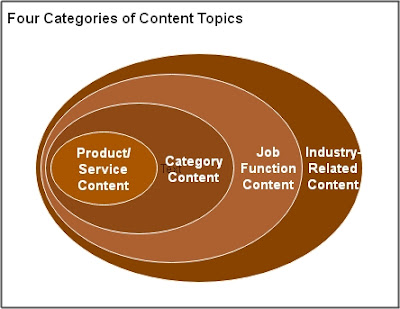
To address these challenges, marketers need to take a broad view of the topics or categories of topics that can be appropriate for thought leadership. From a subject matter perspective, there are four basic types of content (shown in the following diagram).


Product/Service Content - This is just what it sounds like - content that describes the capabilities, features and functionality of a product or group of related products. For a service, it would describe the nature and features of the service.

Having good product/service content is essential for marketing success, but this category is not usually a fertile source of thought leadership content.

Category Content - This type of content discusses issues or needs that a type of product or service can address. When a provider of account-based marketing software creates content that explains why ABM is a more effective approach to marketing or describes the capabilities prospective buyers should look for in an ABM solution, that's category content. Good category content doesn't promote a specific company's product or service, but it often will "evangelize" the product/service category. 

Most of the thought leadership content created by B2B companies is category-based content, and this is the content category that most B2B marketers will focus on first. This is a valid approach, but category content will provide only a finite number of appropriate topics for thought leadership content.

There are, however, two additional types of content that can be good sources of topics for thought leadership content.

Job Function Content - This content category includes topics that address issues relating to the job responsibilities of the individuals who will make or influence the decision to buy a company's product or service - i.e. the members of the buying group. 

For example, if the buying group for your company's product or service includes senior marketing and sales leaders working for companies that manufacture industrial equipment, your thought leadership content could address topics such as:

  • The communication preferences and buying behaviors of industrial buyers
  • The growth of online third-party marketplaces for industrial equipment
Industry-Related Content - This type of content addresses topics that relate to the industry or industries in which a company's prospective customers operate. For example, thought leadership content based on this category could discuss how new or pending environment laws or regulations will impact the target industry or industries.
Cast a Wide Net for Thought Leadership Topics
Some marketers may question the value of creating thought leadership content that isn't closely related to their company's product or service. One of the primary reasons to produce thought leadership content is to demonstrate awareness and understanding of the issues and challenges prospective customers - and the individual members of their buying groups - are facing.
From a marketing perspective, the objective of thought leadership is to engender feelings of trust and confidence in your company by potential buyers. High-quality thought leadership content from any of these content categories can help you achieve this objective.
Developing a sufficient volume of great thought leadership content will always be challenging, but you can make the task a little easier by expanding where you look for thought leadership topics.

Top image courtesy of Grand Teton via Flickr (Public Domain).

Sunday, January 22, 2017

The Promise and Peril of Personalization at Scale


Marketers in virtually all kinds of companies are now intensely focused on improving the quality of the customer experiences their companies provide. Most marketers believe that the ability to personalize marketing offers and messages for individual customers at every touch point is critical to delivering outstanding customer experiences.

Numerous research studies have shown that personalized marketing can be highly effective. For example, in a 2016 survey of more than 1,500 US and UK consumers by Accenture Interactive, almost two-thirds (65%) of respondents said they are more likely to make a purchase from a retailer that sends them relevant and personalized offers. But there are also many well-documented examples of personalized marketing efforts that have failed miserably because they were clumsily executed, or because they were seen as a "creepy" invasion of privacy.

The ability to "personalize at scale" is highly dependent on data and technology. Many companies are already using data and predictive analytics technologies to automatically generate personalized marketing messages without human involvement, and many marketers believe that this practice will only become more commonplace. In fact, it's difficult to envision how personalization at scale can be achieved without a heavy reliance on data and technology.

But this creates a conundrum for marketers that I contend isn't fully appreciated. Automated, data-driven personalization will make personalization at scale more achievable, but it also increases the danger of getting personalization wrong.

An article by Charles Duhigg in The New York Times Magazine provides a great illustration of both the promise and the peril of automated, data-driven personalization. In this article, Mr. Duhigg describes how personalized marketing caused an unwitting father to discover that his teenage daughter was pregnant.

When I decided to write about this topic, my intention was to briefly summarize the content of Mr. Duhigg's article, but I quickly determined that a brief summary simply would not do justice to the subject matter of the article. I strongly recommend that you take the time to read the entire article if you are involved in developing personalized marketing programs.

For me, there are three important takeaways from the article.

  • First, data and predictive analytics can enable marketers to develop marketing messages and offers that are highly relevant for individual customers and prospects. 
  • Second, relevance alone is not enough to ensure that a personalized marketing program will be successful. It takes sound human judgment to evaluate factors that data and analytics simply cannot capture. 
  • And third, sometimes it is more effective to make marketing messages less personalized, particularly when the subject matter touches a highly personal or otherwise sensitive topic.

(Note:  Mr. Duhigg's article is fairly long. The beginning and ending portions of the article contain the material that pertains directly to personalized marketing. The middle part of the article focuses on the power of habit in human decision making. The entire article is well worth reading.)

Image courtesy of Josh Hallett via Flickr CC.

Sunday, January 17, 2016

Why Marketing Can't Always Produce "Goldilocks" Content


Does this scenario sound familiar? You're talking with a marketer for a B2B company, and she says, "We're creating great content - and lots of it - but our sales reps don't use half of the content we develop." Then, you talk with sales reps from the same company, and they say," We need better content! A lot of the content that marketing provides doesn't really help us advance our sales opportunities."

Unfortunately, this scenario is far too common, and it's clear that sales reps don't use content resources produced by marketing for two main reasons. Either they can't find the resources when they need them, or they don't believe the resources will be useful in the selling situation they're facing.

SiriusDecisions recently estimated that 28% of all the content owned by B2B companies goes unused because it's unfindable, and that 37% isn't used because of low quality or lack of relevance. In a survey last year by Demand Metric, only 43% of sales respondents rated their marketing content assets as somewhat effective, and only 3% said they were very effective.

Some people argue that both of these problems can be solved.

  • Sales enablement technology can be used to make content resources easily findable by sales reps, and some sales enablement solutions can use data analytics to recommend specific content resources for specific sales interactions.
  • By collaborating with sales reps during the content development process, marketers can create content resources that will better meet the needs of salespeople.
Technology can certainly be used to make finding content assets easier, and collaboration between marketers and salespeople should enable marketers to develop content resources that will be more compelling to potential buyers. But can marketing be expected to always provide "Goldilocks" content - content that will be "just right" for every interaction that a sales rep has with a potential buyer? I don't think so, and here's why.

One vital characteristic of effective marketing content is personalization. By personalization, I mean the degree to which the material in a content asset is tailored based on the attributes and anticipated interests of the intended recipient. The following diagram shows the six levels of content personalization.


The table below describes each level of personalization.


Today, we know that marketing content should be segment-specific, persona-specific, and stage-specific. In other words, marketers should consistently develop and use content resources that are tailored for specific buyer personas who are affiliated with specific types of prospect organizations, and who are at specific stages of the buying process.

However, it's just about impossible for marketers to develop prospect-specific and lead-specific content because those levels of personalization require insights that can only be gained through personal interactions with potential buyers. So, these types of personalized content can only be produced by someone who is having direct conversations with the potential buyer - and that usually means a business development representative or a salesperson.

Last year, David Brock addressed this issue in a post at his Partners in EXCELLENCE Blog. Dave described prospect-specific and lead-specific content in captivating terms:

"It's marketing content for an audience of 1 - at this very moment . . . It's content that addresses my specific problem, concerns, and priorities right now - because they may be slightly different from those I have tomorrow . . . The content I need comes from you engaging me in conversations and a discussion about what I do, what my people do, what my boss is expecting of me, what my customers and suppliers want . . . It is specific to me and my priorities today."

For the past few years, the conventional wisdom has been that salespeople should not be spending their time developing content. But the reality is, there are some types of content that only a sales rep can produce. Instead of trying to eliminate all salesperson-created content, marketers should support sales reps in performing this vital job. And salespeople should stop expecting marketers to provide ready-made content for every selling situation.

Top illustration courtesy of CW Wells via Flickr CC.

Sunday, July 6, 2014

Great Marketing Content Always Requires Trade-Offs

In a landmark article for the Harvard Business Review, Michael E. Porter wrote that the essence of business strategy is choosing to perform business activities differently - or to perform different activities - than competitors. Porter also argued that a powerful strategy always involves trade-offs. If you design and arrange your activities to excel a delivering a specific value proposition, you will be less able to effectively and efficiently deliver other types of value. Therefore, strategy is about deciding both what to do and what not to do.

A variation of Porter's principle applies to content marketing. To be highly effective, each content resource you develop must be designed to address the concerns and interests of a specific target audience. And when a content resource is truly designed for a specific target audience, that resource will inevitably be less appealing to other audiences, some of which may be important to your company. It can be tempting to design content resources that will appeal to multiple audiences, but this is usually a mistake. The title of a recent blog post by Joe Pulizzi makes the point clearly:  "If Your Content Marketing is for Everybody, It's for Nobody."

Whenever I talk with prospective clients about starting a content marketing program, one of the first questions they ask is:  "Why can't we create one content resource, say a white paper or an e-book, that tells the whole story? It could include a description of the problems we can solve and the benefits our solution can provide, and we could include a couple of customer success stories to demonstrate that we can deliver what we promise."

At this point in the conversation, the image of a Swiss army knife always flashes in my mind. As you probably know, a Swiss army knife is a tool that's about the size of a large pocket knife. In addition to regular knife blades, it has several other attachments, such as a bottle opener, a can opener, a screwdriver, and a file. So, a Swill army knife is a real multi-tasking tool and a handy thing to have on a camping trip or a hike.

Some B2B marketers believe they can create one content resource that will appeal to all of their target audiences and fill all (or most) of their content needs. In essence, they want to create the content marketing equivalent of a Swill army knife. Unfortunately, however, the Swiss army knife approach to content marketing doesn't work well. Here are two of the primary reasons.

Diluted Relevance - When you create a content resource that's designed for multiple audiences, it will inevitably include information that's not very relevant or interesting to some of those audiences. Suppose, for example, that you offer a technology product that must be sold to plant managers, IT directors, and CFO's. Each of these buyer types will have distinct concerns and priorities. If you create one content resource for all of these buyer types, you are essentially asking each potential buyer to wade through material that doesn't particularly interest him or her in order to find the information that addresses his or her primary concerns.

Excessive Length - Even if the relevance problem didn't exist, when you try to "cover all the bases" in one content resource, you are likely to end up with a very long resource. The problem with long content resources is that most potential buyers now have short attention spans. They usually prefer to consume content in small doses, especially when they are in the early stages of the buying process. Most early-stage buyers simply won't be willing to invest the time it takes to read a 50-page white paper or e-book.

The bottom line is that developing good marketing content always requires you to make trade-offs. When you develop a content resource for a specific target audience, it probably won't be appropriate of other audiences. For an effective content marketing program, you'll need distinct resources for most of your primary audiences.

Sunday, March 16, 2014

Match Your Content to the Type of Demand You Need to Create

I've written frequently here about why it's important to develop marketing content resources for specific buyer personas and specific stages of the buying process. This kind of targeted content produces better marketing results because it enables you to increase what I call personal relevance and situational relevance.

There's also another factor you need to consider when developing marketing content. To make your content more effective, you must understand the type of demand you need to create. The demand type concept was developed by SiriusDecisions a few years ago, and it's basically designed to describe where your market is in the typical evolutionary cycle.

SiriusDecisions has identified three demand type categories.

New Concept
A new concept is a truly disruptive product or service. It usually solves a problem that most potential buyers don't know they have, or it may address a condition or set of circumstances that most potential buyers perceive to be an inevitable fact of business life, for which no solution exists.

New Paradigm
A new paradigm is a product or service that will solve a known problem or fill a known need in a new and novel way that differs significantly for other existing solutions.

Established Market
An established market represents a product or service that is accepted by the majority of prospect organizations as necessary and best-of-breed. With an established market product or service, most prospective buyers will understand the nature and ramifications of their need, and they will have a general understanding of what solutions are available.

Obviously, these different market environments require different approaches to content marketing. With a new concept, both marketing and sales must be highly evangelistic. Your first job is to show potential buyers that a given set of conditions constitutes a problem and that an effective solution to the problem exists. Therefore, your marketing content needs to contain a significant thought leadership component that is designed to create awareness of the problem and instill confidence that the problem can be solved.

With a new paradigm product or service, most potential buyers are aware of the problem they need to solve, and they may have already implemented one of the conventional solutions. Therefore, your marketing content must demonstrate why and how the new solution you offer is significantly better than the more conventional solutions. In this situation, your primary competition is the existing solution paradigm rather than other solution providers.

When your product or service competes in an established market, the key to success is differentiating your solution from those offered by your competitors. Since your solution is probably similar in general functionality to those of your competitors, your marketing content needs to emphasize other sources of differentiation, such as a lower total cost of ownership, easier and/or faster implementation, or more responsive customer support.

When you're using these demand types to guide your marketing efforts, it's important to remember that the type of demand you need to create will change as your market evolves. Therefore, to keep your marketing content effective and compelling, it needs to evolve in step with your market.

Sunday, January 26, 2014

Traditional Content Formats Still Dominate Consumption and Influence

Eccolo Media recently published its 2014 B2B Technology Content Survey Report. The 2014 report describes the findings of Eccolo Media's sixth annual survey of technology buyers. All of the respondents in the 2014 survey were responsible for influencing or making technology buying decisions in the six months prior to the survey.

As with the previous Eccolo Media surveys, the 2014 survey (conducted in the fall of 2013) focused on what types of content resources technology buyers used in making purchase decisions, which types of resources they considered most influential, and how they consumed content during the buying process.

The 2014 survey findings reveal the continuing importance of "traditional" content formats (white papers, case studies, etc.) and the growing use of newer formats such as webinars, social content, and web slideshows.

The five most frequently consumed types of content identified in the 2014 survey were:
  • White papers (49% of respondents)
  • Product brochures/data sheets (46%)
  • Case studies/success stories (36%)
  • Detailed technology guides/implementation scenarios (36%)
  • Video/multimedia files (35%)
Eccolo Media also asked survey participants to describe the influence of various types of content on their decision making process. The five most influential types of content, based on the percentage of respondents who said the content is very or extremely influential, were:
  • White papers (50%)
  • Infographics (49%)
  • Detailed technology guides/implementation scenarios (49%)
  • Case studies/success stories (48%)
  • Video/multimedia files (42%)
The 2014 survey report contained a couple of findings that, on the surface, seemed surprising. First, it revealed that the consumption of some very popular types of content resources has declined, as shown in the following table:


In my view, these statistics do not mean that white papers, brochures, case studies, and videos are becoming less critical to effective marketing. What's happening is that B2B companies are offering content in an ever-increasing number of formats, and buyers are taking advantage of the expanded options to consume content in the format they prefer. Therefore, the percentage of buyers consuming a particular type of content can decline, as buyers use a greater variety of content formats.

The second surprise in the Eccolo Media report was an apparent drop in the influence of content. The authors of the report noted that in the 2010 survey, 41% of respondents said that white papers were very or extremely influential. That percentage increased to 65% in 2011, then dropped to 57% in 2012, and fell to 50% in 2013. The report authors said they saw similar results in other content categories.

These findings do not indicate that content is becoming less influential. In fact, research by other firms has demonstrated that content is becoming more influential in the B2B buying process. What has occurred is that buyers have become more discriminating when it comes to content. The growing popularity of content marketing means that buyers have access to more content than ever before, and they are more willing than ever to distinguish between good content and bad content. Only content that provides real value will be viewed as influential.

The Eccolo Media survey also provides insights on this aspect of the influence issue. The survey asked respondents about their likes and dislikes in white papers, case studies, and videos. Here's how the report authors described what respondents dislike in white papers:

"Respondents are most disappointed by too much focus on vendor or product information. That's supported by recent findings from other studies. Technology buyers rate 'too much marketing hype,' 'lack of truly independent, unbiased information,' and 'information is too general' as their top three content problems, according to IDG Enterprise."

The most important takeaway from this report is that B2B companies must continue to produce compelling white papers, case studies, and other "traditional" forms of content, but that it's also critical to offer content in several of the "newer" formats.

Thursday, December 26, 2013

Our Most Popular Posts - 2013 Edition

This will be my last post in 2013, and I want to thank everyone who has spent some of his or her valuable time reading this blog. I hope that you have found the content here to be both thought-provoking and useful.

Thanks to analytics, I can see how many times each blog post has been viewed. I thought this would be an appropriate time to share which posts have been most widely read. This ranking is based on cumulative total reads, and therefore older posts obviously have a built-in advantage.

So, in case you missed any of them, here are our five most popular posts.

Use an Importance-Performance Matrix to Get Marketing and Sales Talking - This post explains how to use an importance-performance matrix to capture the degree of agreement or disagreement between marketing and sales regarding key demand generation activities. An importance-performance matrix won't tell you how to resolve conflicts between marketing and sales, but it will identify the issues you need to address.

Why Content Marketing is the Best Way to Build the Brand - Some respected marketing industry experts have argued that content marketing has made brand marketing or "building the brand" obsolete. This post argues that building the brand is still an essential marketing objective for B2B companies and that content marketing is now the best marketing tactic to use for branding. For another perspective on the importance of brand building, see Why B2B Branding Still Matters.

Why BANT No Longer Works for Qualifying Leads - One of the most widely-used methods for qualifying B2B sales leads is known by the acronym BANT, which stands for Budget-Authority-Need-Timeline. This post argues that BANT is no longer an effective way to qualify sales leads. In a later post - Rethinking the Value of BANT (It's Not as Outdated as Some Suggest) - I revisited this topic and argued that the BANT criteria can still be useful for qualifying leads if they are used at the right times to answer the right questions.

Stop Wasting Your Time on Superficial Personalization - For over two decades, experts have urged marketers to use personalized messages to boost the effectiveness of marketing communications. The most common way to personalize a marketing message is to include specific facts about the recipient in the message - what I call explicit personalization. This post discusses the findings of two research projects which demonstrate that explicit personalization alone has become an anemic tool for improving marketing effectiveness.

It's Time to Integrate Marketing and Sales - Marketing and sales "alignment" has been a hot topic among B2B marketing and sales professionals for some time. This post argues that it may be time to move beyond mere "alignment" and actually integrate the marketing and sales functions. In a later post - Four Key Ingredients in the Marketing/Sales Integration Recipe - I discussed four critical requirements for integrating marketing and sales.

Happy New Year, everyone!

Saturday, September 14, 2013

Stop Wasting Your Time on Superficial Personalization

For more than two decades, experts have urged marketers to use personalized messages to boost the effectiveness of marketing communications. Many marketers have heeded this advice, and they are now using various technology tools to create personalized marketing messages in a variety of media and formats, including web pages, e-mail messages, and printed materials such as direct mail documents.

The most common way to personalize a marketing message is to include specific facts about the recipient in the message. Some examples would include the recipient's name, her job title, company affiliation, the industry in which she works, or information about a recent purchase.

The reality is, this type of explicit personalization no longer has much impact with potential buyers, largely because so many marketers are using similar personalization tactics. Two recent research projects have confirmed that explicit personalization alone has become an anemic tool for improving the effectiveness of marketing communications.

Earlier this year, the Economist Intelligence Unit (EIU) conducted two concurrent surveys sponsored by Lyris. One of the surveys was directed at consumers, and it asked survey participants about the effectiveness of various marketing channels and tactics, how they prefer to engage with brands, and what influences their purchase decisions. You can obtain an executive summary of the EIU survey report here.

The major findings from the EIU consumer survey regarding personalization include the following:
  • More than 70% of survey respondents said that the volume of personalized messages they receive has increased over the past five years.
  • Seventy percent of the respondents said that many of the personalized messages they receive are annoying because the attempts at personalization are superficial.
  • Sixty-three percent of respondents said that personalization is now so common that they have grown numb to it.
  • Only 22% of respondents said that personalized offers are more likely to meet their needs than mass market offers.
Research by the CEB Marketing Leadership Council also shows that explicit personalization has lost much of its impact. In July of this year, CEB surveyed 1,500 consumers from the United States, the United Kingdom, and Australia regarding how, why, and what they buy, and about their attitudes regarding the tactics brands use to engage them. One of the survey questions asked participants how they felt about some of the more common forms of explicit personalization. The table below shows how the survey participants responded.


The lesson here is that explicit personalization alone is not sufficient to make marketing messages more effective. The real key to improving the effectiveness of your marketing messages is to use what you know about your potential buyers to craft messages that will be more relevant and useful to those buyers. Relevance and usefulness (what Jay Baer calls "Youtility"), not mere personalization, are the real drivers of better marketing results.

This doesn't mean that you should stop personalizing marketing messages. It does mean that the personalization should be contextually appropriate (not just a gimmick) and that personalization shouldn't be the core component of your messaging strategy.

Sunday, March 10, 2013

Three Questions Your Content Marketing Plan Must Answer

It's now abundantly clear that content marketing is a core marketing tactic for many companies. Research by the Content Marketing Institute suggests that nine out of ten B2B companies are using content marketing in some form.

Developing a content marketing program is a significant undertaking for any company. Not only does it require the creation of new content resources and the implementation of new marketing tactics, it also involves a fundamental shift in the philosophical approach to marketing.

When I'm talking with clients about implementing a content marketing program, one question that always comes up early in the conversation is: "How do I get started?" I always answer this question by saying that the first step is to develop a content marketing strategy and plan for the business. That answer usually leads to a second question:  "What should be included in a content strategy/plan?"

A complete content marketing plan will address numerous issues and contain significant detail, but at the most basic level, a content plan must answer three fundamental questions:
  • What issues or topics will the content resources address, and how will the resources be made relevant for potential buyers?
  • What digital and/or physical formats will be used for marketing content resources?
  • When and how will content resources be published, distributed, or otherwise brought to the market, and how will they be promoted?
Like the proverbial three-legged stool, the answers to these three questions define the core elements of your content marketing strategy and plan. What makes these three questions particularly critical is that they apply both to the overall content marketing plan and to individual content resources. In other words, every time you contemplate the creation of a new content resource, you need to determine what issues it will address and how it will be tailored for a specific target audience, what format will be used for the resource, and how the resource will be published, distributed, and promoted.

Of these three questions, the first is by far the most important. One of the biggest content marketing mistakes that I see companies make is allowing format, rather than message, to drive the content development process. Marketers sometimes say, "We need a white paper [or an eBook or a Webinar]," rather than, "We need a content resource that communicates message X to audience Y." If you want to create an effective content marketing program, think messaging first, and then format and distribution.

I've published several posts here that discuss how to make content messaging more effective. In case you missed those posts, here are the links:

Sunday, August 21, 2011

What It Takes to Make Marketing Content More Compelling

There's no longer any doubt that relevant marketing content is essential for B2B marketing success.  Business buyers are incredibly busy, and they're exposed to hundreds of marketing messages every day.  The only reliable way to cut through the clutter and create meaningful engagement with potential buyers is to provide marketing content that prospects will see as relevant and compelling.

The big question for marketers is, how do we create this kind of content?  We often hear or read that the answer is to customize marketing messages and materials for specific buyers.  But, what kinds of "customization" will actually increase marketing relevance and effectiveness?

There are two proven ways to make marketing content more relevant and compelling.  The first key is to make it easy for prospects to identify with your content.  To do this, you'll need content that's customized to fit the personal and professional characteristics of your potential buyers.  What jobs do your prospects hold?  What kinds of companies do they work for?  What size companies do they work for?  So, for example, if your target prospects are plant managers in small manufacturing companies, you'll need content that's tailored for that kind of buyer.

This kind of content customization increases what I call personal relevance, and it's proven to increase marketing effectiveness.  In research by MarketingSherpa, 82% of business buyers said that marketing content was more valuable when it was targeted to their industry.  Sixty-seven percent of buyers said that marketing content was more valuable when it was targeted to their job function, and 49% said the same for content that was targeted to companies of similar size.

The second way to increase relevance is to create and use marketing content that speaks to issues that have immediate importance to your prospects.  Most B2B buyers move through an identifiable set of buying stages as they make purchase decisions, and the issues that are most important to buyers will change as they move through the buying process.  If your marketing content provides a potential buyer information that's out of sync with his or her decision making process, it's far less likely to capture the buyer's full attention.

The solution is to use marketing messages and materials that are designed for each stage of the buying process.  This kind of content customization enhances what I call situational relevance, and it can provide powerful competitive advantage.  In a recent survey of B2B buyers by DemandGen Report, 93% of respondents said the solution provider they chose supplied ample marketing content to navigate through each phase of the buying process.

A few weeks ago, I published a white paper that describes these two ways to make your marketing content more relevant.  If you'd like a copy of this white paper, send an e-mail to ddodd(at)pointbalance(dot)com.

Wednesday, June 8, 2011

Making Localized Marketing Easy and Affordable

In my last post, I briefly described how marketing asset management solutions work.  These solutions automate many of the processes relating to the procurement, production, management, and distribution of marketing materials such as marketing collateral documents, promotional items, and point-of-sale materials.

Marketing asset management solutions can dramatically reduce the indirect costs associated with marketing materials, but they can provide many other benefits as well.  One of these benefits is to make localized marketing easy and affordable.

Marketers have long recognized that customizing marketing materials for specific audiences will increase relevancy and improve the effectiveness of those materials.  One proven application of this tactic is known as localized marketing.  Localized marketing is just what it sounds like - the practice of customizing marketing materials for local audiences.  In can be as simple as adding local contact information to otherwise standard marketing collateral materials or as complex as creating an entire promotional program (direct mailers, print ads, point-of-sale materials, etc.) that is customized for a specific geographic market or buyer segment.

Unfortunately, localized marketing has traditionally been cumbersome, time-consuming, and costly.  Marketers who wanted to reap the benefits of localized marketing were usually forced to make an unattractive trade-off between keeping control of the brand and excessive costs.

Marketing asset management solutions can eliminate the barriers to localized marketing.  By using customizable templates for marketing materials, MAM solutions enable corporate marketers to retain control of brand messaging and brand presentation, while simultaneously enabling front-line marketers (salespeople, local store/branch managers, dealers, franchisees, etc.) to customize marketing materials to fit their marketing needs.

Would a marketing asset management solution make sense for your company?  To find out, read our white paper titled, Is a Marketing Asset Management Solution Right for My Company?  Request your copy by sending an e-mail to ddodd(at)pointbalance(dot)com.

Wednesday, July 28, 2010

How MSP's Can Take Advantage of B2B Marketing Automation - Part 1

The use of marketing automation technologies by B2B companies is growing rapidly, and the growth is likely to continue for the foreseeable future.  Marketing service providers who serve B2B companies need to be aware of this trend because it changes the way B2B companies approach marketing and the kinds of marketing services they will require - and be willing to pay for.  To fully realize the benefits of marketing automation, B2B companies will need to define marketing and sales processes more precisely, and they will need to implement new marketing techniques. Marketing service providers who can help B2B companies make these changes stand to win new clients and boost revenues.


The best way to identify the kinds of marketing services that are likely to see increased demand is to identify the tasks that B2B companies must perform in order to take full advantage of marketing automation systems. There are eight major tasks that are essential to implementing and successfully using marketing automation technologies. Most of these tasks provide the foundation for new marketing techniques that many B2B companies have not previously used. Therefore, many B2B firms – especially small and mid-size companies – will need assistance to perform some or all of these tasks, and that’s what creates the opportunity for savvy marketing service providers. I’ll describe two of these major tasks in this post, and I’ll cover the others in my next few posts.

Creating an Ideal Customer Profile – This task is right out of Marketing 101, and it should be a core component of every company’s marketing process, whether or not marketing automation is involved. An ideal customer profile is simply a description of the kinds of companies that make the best customers and, by extension, the most attractive prospects. The ideal customer is usually described in terms of “firmographics” such as industry classification, company size, and geographic location. The ideal customer profile is used to shape lead generation programs, and it is one major component of the lead scoring system that will be set up as part of the marketing automation implementation.

Obviously, a marketing service provider cannot decide what a client’s ideal customer profile should be. The role of the MSP is to lead the client through a process that is designed to ensure that all the right questions are asked and that all the appropriate factors are considered.

Developing Buyer Personas – Most B2B buying decisions are made (or significantly influenced) by a group of people rather than by one individual. This is true even in relatively small companies. Research firm MarketingSherpa says that in companies having between 100 and 500 employees, the average number of people involved in buying decisions is 6.8. This buying group is usually composed of individuals who have different points of view regarding a proposed purchase. For example, a “user buyer” will usually have different priorities than a “technical buyer” or an “economic buyer.” To market to these buyers effectively, a company must develop marketing content that addresses the specific needs of each type of buyer in the buying group. The basis for developing such content is buyer personas.

A buyer persona is a biographical sketch of a typical buyer. It is more than a job title. Buyer personas are written in narrative form, and they are written as if the archetypical buyer is a real human being. A company needs to create a persona for each type of buyer who significantly influences the purchase decision. Marketing automation systems enable companies to create and execute marketing programs that are customized for each type of buyer, but the starting point for leveraging this functionality is the creation of buyer personas.

To develop a complete buyer persona, marketers must answer several questions about each type of buyer. Here are some examples:

•What are the buyer’s major business objectives and job responsibilities?
•What strategies and tactics does the buyer use to achieve his objectives and fulfill his responsibilities?
•What measures are used to evaluate the buyer’s job performance?
•What issues and problems keep the buyer awake a night?
•How old is the typical buyer? [Age range is OK]
•Is the buyer typically male or female?
•What is the typical buyer’s educational background?
•What sources does the buyer turn to for information?
•How would the buyer describe the issues he or she is facing?

As with the ideal customer profile, an MSP cannot build buyer personas “for” a client, but the MSP can lead the client through the process of developing buyer personas that will drive relevant and effective marketing.

In my next post, I’ll cover two more tasks relating to marketing automation that MSP’s can help B2B marketers perform.

Thursday, March 25, 2010

Getting Specific About Value

We now know that providing relevant content to potential buyers is essential for effective B2B marketing.  One key to increasing the relevancy of marketing content is to make it more specific.  Consider the following two statements:
  • "Our new ProWidget can enable you to reduce equipment downtime and improve manufacturing efficiency."
  • "Customers using our new ProWidget have reduced the cost of equipment downtime by an average of $100,000 per year."
Which of these statements is more compelling?  I think it's clear that the second statement is more powerful because it's more specific.

To make marketing content more specific, you need to have a thorough understanding of how your products and services produce value for customers.  In an earlier post, I explained how to build a customer value matrix that will provide detailed insights about this critical issue.

Now for a confession.  You may need more than one customer value matrix to get a complete picture of how your products and services produce value for customers.  This is likely to be true if you sell to more than one industry or type of business.

To understand why, we need to review a few principles about value.  All products and services have features and attributes that enable certain jobs to get done.  By providing ways to get things done, features and attributes produce benefits for the people and companies that use the product or service.  The value of any product or service depends on the value of the benefits the product or service produces.

The catch is that the value of any particular benefit can vary significantly from customer to customer depending on the nature of each customer's business. 

To capture these differences, you need to create a separate customer value matrix for each industry or major type of business you serve.  After you've created your initial "catch-all" matrix, think about one of the industries of major types of business your serve.  Go back through your catch-all matrix and create a separate version that is targeted to that industry or type of business.  What you are likely to find is that some benefits or sources of value become much more important when you're focused on one particular type of business.  This insight will enable you to develop content that is more specific, and therefore more relevant, to that industry.

Monday, March 15, 2010

Personalization Alone Doesn't Create Relevance

Today's B2B marketers have more ways to reach out to customers and prospects than ever before.  Digital technologies have created new marketing channels and enabled marketing techniques that would have been impractical, if not completely impossible, only a few years ago.

But despite the new marketing channels and technology tools, most B2B marketers are finding it more difficult to capture the attention of potential buyers and create the kind of engagement that leads to new business.  Easy access to information makes B2B buyers less dependent on sellers than in the past, and our environment is filled with advertising and marketing clutter.

As I've written before, the real solution to overcoming these hurdles is to use marketing messages that are relevant to the problems and issues B2B buyers are facing.

The good news is that B2B marketers now have an array of tools to improve the relevance of marketing communications.  Personalization technologies can enable marketers to create marketing messages that are customized for individual prospects.  For example, marketers can use variable data printing to create direct mail pieces that are customized for each recipient.  Other personalization technologies make it possible to create customized e-mail messages and Web pages.

The capabilities of personalization technologies are impressive, but it's important to remember that personalization alone does not necessarily create relevance.  For some time, marketers have been personalizing marketing messages by including specific facts about the recipient - her name, job title, or company affiliation, for example - in the message.  I call this explicit personalization, and the reality is that explicit personalization alone won't make an irrelevant message relevant.

Effective marketing can be defined as getting the right offer in front of a potential buyer at the right time.  Information about a potential buyer - particularly the buyer's behavior - can be a powerful tool for determining what the right offer should be and when that offer should be presented.  When personal information is used this way, the result is a personalized, customized, and relevant marketing message.  What makes this kind of message different from one based only on explicit personalization is that the personalization is embodied in what the offer is and how it is presented, rather than in a collection of "facts" about the recipient.

All relevant marketing messages are in a very real sense personalized, but not all personalized messages are relevant.

Friday, February 26, 2010

More Proof That Relevant Marketing Content is Essential

Earlier this week, I attended a Webinar titled Inside the Mind of the B2B Buyer - New Data on the Path to Purchase.  This Webinar discussed the results of a recent survey that was conducted by DemandGen Report and sponsored by Genius.com.  The survey targeted B2B buyers who had made a recent purchase.

The lead finding in the survey is that more than 80% of buyers said they initiated contact with potential solution providers.  Fewer than 10% of recent buyers said that they were contacted "cold" by the solution provider.  This finding is similar to the results of other recent research, and it reinforces the proposition that, today, buyers find sellers much more often than sellers find buyers.

The DemandGen Report survey also provides important insights into the behavious of today's B2B buyers.
  • 70% of buyers began their research using online search
  • 70% of buyers started their research by visiting a vendor Website
  • 78% of buyers started their purchasing process with informal information gathering
  • 59% of buyers engaged with peers during the buying process
  • 48% of buyers followed industry conversations online
  • 44% of buyers conducted anonymous online research
These results clearly demonstrate why marketing content is so critical to B2B marketing success.  Potential buyers are forming opinions about your company and your products and services based on the content you provide - often long before you even know who the potential buyers are.

This survey also confirms that compelling marketing content has a major impact on winning business in today's business environment.  Ninety-five percent of recent purchasers said that the solution provider they ultimately chose provided them with ample content to help them navigate through each stage of the buying process.

So, the jury is in and the verdict is clear.  Relevant and compelling content is essential for effective B2B marketing.

You can access a recorded verison of the Webinar here.

Monday, February 8, 2010

There's No Substitute for Relevancy

In my previous post, I described some of the characteristics of today's B2B buyers, and I said that because of easy access to information, business buyers now essentially control the buying process. Buyer empowerment is one of three forces that are shaping the B2B marketing landscape. Just like moving water shapes the physical world, these three forces are redefining what effective B2B marketing is and how it's done. The third force is marketing automation technologies, and I'll cover this topic in my next post.

The second force driving fundamental change in B2B marketing is the growing need to create and use marketing communications and materials that are relevant to potential buyers. Relevance has become a necessity for two reasons. First, our environment is filled with marketing and advertising clutter, and the clutter is getting worse, not better. As marketing clutter increases, the effectiveness of generic, self-promotional marketing messages decreases. B2B buyers simply tune them out. Second, today's B2B buyers are incredibly busy. Their time is their most precious commodity, and they protect it at all costs. If a buyer doesn't see your message as relevant, he or she will ignore it.

The dictionary definition of relevant is, "having significant and demonstrable bearing on the matter at hand." Therefore, to be relevant, a marketing message must speak directly to an issue, problem, challenge, or outcome that's important, or at least interesting, to the potential buyer.

To create relevance, you have to know two things about your potential buyer. First, what role does the buyer play in his or her organization, and how will your products or services create value for this specific buyer? How do they make his life easier? What problems do they help her solve? Most B2B sales involve several "buyers" and these buyers will have different needs, issues, and problems. This means that you need to create marketing messages and materials that are customized for each type of buyer you typically encounter. In an upcoming post, I'll describe how you create buyer "personas" and then develop marketing materials for each persona.

The second thing you need to know is where the buyer is in the buying cycle. This is important because the kind of information that a potential buyer will find relevant changes as he or she moves through the buying process. For example, a prospective buyer who has just started to focus on a particular problem will likely welcome a white paper that explains the ramifications of the problem and the benefits of solving the problem. That buyer would not be as likely to welcome a product brochure at this stage of the buying process. So your marketing messages and materials must also speak to where your prospect is in the buying cycle.

The growing need to make marketing messages and materials relevant multiplies the amount of marketing content you need and, therefore, complicates the B2B marketing process. But relevance is absolutely essential to reach today's B2B buyers.