Sunday, October 19, 2014

The Business Case for Interactive Content Marketing

It's now clear that content marketing has become a core marketing strategy for most B2B companies, and the use of content marketing is continuing to grow. Findings from the latest annual content marketing survey by the Content Marketing Institute and MarketingProfs reveal both the pervasiveness and expansion of content marketing.

  • 86% of survey respondents said their companies are using content marketing.
  • 70% of respondents said they are producing more content than they did one year ago.
  • 55% of respondents said they plan to increase or significantly increase their content marketing spending.
When it's done correctly, content marketing is the most effective way to create meaningful engagement with today's empowered and independent buyers. However, I suggest that we are beginning to see signs of content fatigue. The irony is that the growing popularity of content marketing is contributing to content fatigue and creating a new challenge for marketers. As more and more companies publish more and more content, it's becoming more difficult to make your content stand out.

Of course, the need to create content that captures the attention of prospects and triggers engagement is not new. In all five of the annual content marketing surveys by CMI/MarketingProfs, producing engaging content has been one of the three top challenges identified by survey respondents. The explosive proliferation of content and the resulting content fatigue have only added to the challenge.

Recent research by Demand Metric reveals that interactive content can be a powerful weapon for combating content fatigue. In the Demand Metric study, interactive content was defined as content that invites or requires some level of active involvement by the prospect. The survey provided study participants several examples of interactive content, including wizards, configurators, assessments, quizzes, calculators, and games. Passive content was defined as content that invites or requires little or no interaction by the prospect beyond reading, viewing, or listening.

Demand Metric asked study participants to categorize their content using one of five options - very passive, somewhat passive, moderate, slightly interactive, or very interactive. Then, Demand Metric grouped the responses into two broader categories. The passive content category included the "very passive," "somewhat passive," and "moderate" responses, while the interactive content category included the "slightly interactive" and "very interactive" responses.

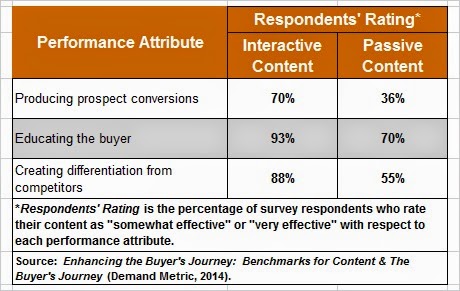
Next, Demand Metric asked survey participants to rate the effectiveness of their content at performing three critical marketing functions - producing prospect conversions, educating the buyer, and creating differentiation from competitors. Finally, Demand Metric compared the ratings of interactive content users with passive content users.

The table below shows the results of this comparison, and the results demonstrate clearly that interactive content is better than passive content at performing all three vital marketing functions.


The use of interactive content is not new. Some companies, primarily larger enterprises, have been using configurators, assessments, and calculators for several years. But, the interest in interactive content is growing rapidly, and the technology required to produce interactive content at scale is becoming more affordable. Therefore, the next major phase in the evolution of content marketing may well be the marketing app.

Sunday, October 12, 2014

Why Your Content Marketing Should Alienate (Some) Prospects

Recently, I attended a webinar presented by Doug Kessler titled Insane Honesty in Content Marketing. If you're not familiar with Doug Kessler, he's one of the co-founders of Velocity Partners, a content marketing agency based in the UK. Velocity consistently publishes great resources regarding content marketing, and this webinar is a must-see for B2B marketers.

According to Kessler, insane honesty in content marketing consists of:

  • Actively seeking out your weaknesses and sharing them openly; and
  • Strategically putting your worst foot forward.
Obviously, this approach runs counter to a whole laundry list of widely-accepted marketing principles and practices, and the idea is probably difficult for many marketers to swallow. In the webinar, Kessler shared several examples of insane honesty at work, which is another good reason you should view the presentation.

Six Reasons to Practice Insane Honesty

Kessler identified six reasons to practice insane honesty in your content marketing:
  1. It surprises and charms - Because this type of content is rare, it is more likely to capture the attention of potential buyers.
  2. It signals confidence - Kessler contends that confidence is the most powerful attribute of all effective content marketing.
  3. It builds trust - If you're insanely honest about the weaknesses of your solution, potential buyers will be more likely to trust what you say about the strengths and benefits of your solution.
  4. It alienates less likely buyers.
  5. It attracts your ideal prospects.
  6. It focuses your sales and marketing team on the battles you can win.
All of these reasons are important, but I want to focus on reason #4 in this post. Marketing content that is insanely honest will alienate some of your prospects, and that is a good thing because of the economics of B2B demand generation.

Insane Honesty Supports Economic Demand Generation

The diagram below illustrates the point that your investment in a prospect increases as the prospect moves through the marketing/sales funnel. On average, you will have much more invested in a Sales Opportunity than you will in an Inquiry. Therefore, it's important to determine whether your solution is a good "fit" for a prospect as early as possible in the prospect relationship.


Marketing content that is insanely honest serves two critical marketing objectives. It functions as a magnet that simultaneously attracts prospects who are a good fit for your business and repels those who aren't. The result is a more effective and efficient demand generation process and a lower likelihood of winding up with frustrated and unhappy customers.


Sunday, October 5, 2014

More Insight on the Content Preferences of B2B Buyers

DemandGen Report recently released the results of its 2014 B2B Content Preferences Survey. The 2014 survey received responses from 105 buyers of B2B products and services. It asked survey participants about their use of content in making purchasing decisions. About 38% of the survey respondents held C-level or VP-level positions at their companies, while almost 27% held director-level positions.

The results of the 2014 survey are not terribly surprising. For the most part, they are similar to the findings of DemandGen's 2013 content preferences survey, and they are also similar to the results of several other research studies, such as the 2014 B2B Technology Content Survey conducted by Eccolo Media. Still, the 2014 DemandGen survey provides several insights for B2B marketers. Here are a few of the survey's major findings:

  • Content is more important than ever - Three-fourths (75%) of survey respondents said they rely on content more than they did a year ago.
  • Desktop and laptop PC's remain the primary tools for accessing business-related content, but mobile phones and tablets are growing in importance - Ninety-five percent (95%) of respondents said they frequently use a desktop or laptop PC to access content, while 56% said they frequently use a mobile phone, and 42% indicated that they frequently use a tablet.
  • Buyers trust user-generated content most - Sixty-five percent (65%) of respondents said they frequently give more credence to content that includes peer reviews and user-generated feedback. Forty-three percent (43%) of respondents said they frequently trust content that is authored by a third party and sponsored by a vendor, and only 13% said they frequently give more credence to content that is created directly by a vendor.
The authors of the DemandGen survey report noted that the popularity of white papers fell by 5% in 2014. However, the survey also revealed that B2B buyers still rate white papers as the most valuable type of content. The 2014 survey included this question:  "What do you feel are the most valuable online content formats for researching B2B purchases? (rate on a scale of 1 to 5 with 1 = most effective)" The table below shows the percentage or respondents giving each content format a "1" rating.


One important takeaway from the DemandGen survey results is that white papers authored by third-party experts are still one of the most powerful and effective types of marketing content that B2B companies can use.

You can get a copy of DemandGen's 2014 B2B Content Preferences Survey report here.

Sunday, September 28, 2014

Marketing Strategy is Vital - Marketing Plans are (Nearly) Worthless

Most business leaders now agree that today's competitive environment is more volatile, uncertain, and complex than ever before, and that companies must constantly adapt in order to grow and prosper. While volatility, uncertainty, and complexity affect all aspects of business, they are having a profound impact on marketing. The interests, values, and preferences of today's consumers and business buyers can change rapidly, and marketers must be ready to respond quickly to these changes.

Marketing leaders now recognize that the explosive pace of change in the marketing landscape has made flexibility and agility critical attributes of effective marketing. The need for adaptable and responsive marketing has caused some pundits and practitioners to question whether a long-term, strategic approach to marketing is still useful. In addition, it can be easy to argue that the growing use of agile marketing techniques eliminates the need for (or at least diminishes the value of) marketing strategy. The fundamental issue is:  Is marketing strategy still necessary and valuable when the recipe for effective marketing seems to be constantly changing?

The argument that marketing strategy no longer matters goes something like this:  "The future is inherently unpredictable, so why worry about a marketing strategy? Why spend the time developing a marketing strategy when competitive conditions are just going to change anyway, and there's no way to be certain that any given strategy will be relevant in the future? What companies should do is focus on reacting quickly to changes as they occur."

On the surface, this argument sounds reasonable, but it is deeply flawed. The reality is, increased volatility, uncertainty, and complexity make marketing strategy more, not less, important. Many marketers find the argument appealing because they confuse marketing strategy with marketing plans.

Marketing Plans Focus on Tactics

Over the past twenty-five years, I've reviewed dozens of marketing plans, and I've found that they inevitably emphasize marketing tactics, specifically marketing communication tactics. For example, a marketing plan will typically describe where and how much TV, radio, and print advertising will be used, what direct marketing campaigns will be run, and how marketers plan to leverage social media marketing. In B2B companies, the marketing plan will also identify the trade shows and other events the company will participate in. In short, marketing plans talk a lot about marketing tactics, but give little attention to marketing strategy.

Marketing Strategy Deals with Different Issues

Strategy has been defined in a multitude of ways over the years. Roger Martin, former Dean of the Rotman School of Management and co-author of Playing to Win:  How Strategy Really Works, provides a definition that captures the essence of strategy pretty well. In his book, Martin says that strategy is a set of choices that provide the answers to five questions:

  • What is our winning aspiration (what does success look like)?
  • Where will we play (what kinds of organizations and/or individuals will we seek to serve, what products and/or services will we offer, and where, geographically, will we compete)?
  • How will we win (how will we create value for our customers)?
  • What capabilities need to be in place?
  • What management systems must be instituted?
These five questions relate to overall business strategy, but with a few slight modifications, they can easily be used to define the essential components of marketing strategy.

Strategy and Tactics Have Different Shelf Lives

It should be obvious that marketing strategy and marketing tactics deal with very different issues. Just as important, marketers must remember that strategy and tactics have different shelf lives.

Marketing strategy focuses (or should focus) primarily on what kinds of organizations or people your company will seek to serve and on how you will create value for those customers. These choices do not change all that frequently, even in today's volatile environment. Marketing tactics, on the other hand, can and should be constantly adapted to address changing buyer interests, concerns, and communication preferences. The tactics that work well today, may be far less effective in a few weeks or months.

Marketing strategy guides and provides the context for your tactical marketing activities. That makes marketing strategy vital for effective marketing. Marketing tactics must be constantly tweaked in response to future conditions that are inherently unpredictable. That makes marketing plans that extend for more than a few weeks into the future almost worthless.

Sunday, September 21, 2014

How Agile Marketing Improves Business Performance

Most marketers now recognize that flexibility, adaptability, and responsiveness have become critical attributes of successful marketing. The interests, values, and communications preferences of today's buyers can all change rapidly, and marketers must always be prepared to deal with a competitive environment that's constantly evolving.

Marketers no longer have the luxury to spend months crafting large marketing campaigns and programs that are designed to run for weeks or months. In today's fast-paced, always-on marketing environment, marketers must be able to produce on the fly, and continuously adapt their marketing tactics and content to changing competitive conditions.

The demand for more adaptable and responsive marketing has given birth to a new marketing discipline that's known appropriately as agile marketing. Agile marketing is derived from agile software development. It's based on several principles, but the primary focus is on rapid prototyping, small-scale experimentation, and breaking marketing activities into small tasks that can be completed in a relatively short period of time (a week or a few weeks at most).

Over the past couple of years, a growing number of companies have implemented agile marketing in some form, and recent research has demonstrated that agile marketing produces significant benefits. For example, CMG Partners recently released the results of a qualitative survey that involved interviews with more than 40 CMO's, other marketing leaders, and agile marketing experts. The survey included both respondents from companies that had implemented agile marketing ("agile users") and respondents that had not yet adopted agile marketing ("non-users").

The results of the CMG Partners research clearly show that agile marketing drives improved business performance. For example:

  • 88% of non-users said that improving speed to market is a priority, while 93% of agile users said that adopting agile marketing had helped them to improve time to market (in terms of ideas, products, or marketing campaigns).
  • 91% of non-users said that being able to change direction more quickly and effectively is a priority, while 93% of agile users said that agile marketing helped them to change marketing messages and tactics more quickly and effectively.
  • 96% of non-users said that improving the productivity of their marketing team is a priority, while 87% of agile users said that implementing agile marketing had made their team more productive.
Some readers may wonder whether agile marketing is compatible with a longer-term strategic approach to marketing. Given the focus on short-term projects, small-scale experiments, and the use of feedback loops to drive frequent iterations of marketing programs, it would be easy to conclude that agile marketing eliminates the need for (or at least diminishes the value of) marketing strategy.

This is an important issue that I'll address in a future post. For now, let me just say that a well-conceived marketing strategy is critical for effective agile marketing because the strategy provides the essential context for agile marketing activities.

What's not open to debate is that marketing must be flexible and adaptable to succeed in today's volatile environment.

For a great introduction to agile marketing, take a look at this presentation made by Scott Brinker, a co-founder and the CTO of ion interactive, inc. Scott is also the author and editor of the Chief Marketing Technologist blog, which I strongly recommend that you read regularly.

For more about the CMG Partners research, read this article at Forbes.

Sunday, September 14, 2014

Stop Looking for "Silver-Bullet" Solutions in Marketing

In the sixteenth century, Spanish conquistadors in South America heard stories about a king who made an offering of gold and precious gems to his god as part of a religious ceremony. The Spaniards called the king El Dorado, and over time El Dorado came to mean the city of this king. According to the legend, El Dorado contained gold and precious stones in fabulous abundance. The legend was so powerful that for over two centuries, European explorers mounted numerous expeditions to search for El Dorado.

So far as we know, the "city of gold" was never found.

It's only human to long for simple and easy solutions to complex or difficult problems. At least once in our lives, most of us have yearned for a magic diet pill that would enable us to lose twenty pounds in four weeks without eating less or exercising more. Usually, we know this is just wishful thinking, but in some cases, our desire for simple solutions rises above mere wishful thinking. The number of self-help books that are sold every year demonstrates that millions of us are willing to believe that simple solutions for difficult challenges do, or at least might, exist.

The desire for simple solutions can also be found in the business world. Nowhere is this more evident than in the attempt to answer the most basic of all business questions:  What drives high performance? Over the past few decades, the effort to describe the "secret sauce" for achieving high performance has probably consumed more brainpower than any other single business topic. It has been the modern-day business equivalent of the quest for the Holy Grail or the search for El Dorado.

Since the early 1980s, dozens of books - most written by talented and well-respected authors - have purported to explain how companies achieve high performance. Some of these books describe the important attributes that high-performing companies share. The implicit (and often explicit) promise is that if you can develop these attributes in your business, you too will achieve high performance. Other books focus on specific management tools or techniques. Once again, the implicit promise is:  Use this tool or technique, and high performance will inevitably follow.

Despite the best efforts of a lot of very smart people, the recipe for high performance has remained elusive. No one has been able to get it quite right.

The desire for "silver-bullet" solutions is also widespread in the marketing world. Over the past few years, the number of marketing channels and techniques has exploded, largely because of the evolution of digital communication technologies. When a promising new marketing channel or technique appears, the marketing community often responds with great excitement. The "shiny new object" becomes the topic du jour for articles, blog posts, webinars, conference sessions, and even full-length books. As the hype machine kicks in, it becomes almost impossible not to overestimate the value that the new channel or technique will provide.

The basic problem is that success in marketing is far more complex and unpredictable than most people like to admit. The marketing world is not ruled by the kinds of precise laws that govern the natural world. For example, if I apply heat to water, the water will boil when the temperature reaches 212 degrees Fahrenheit. I can repeat this "experiment" thousands of times, and the result will always be the same. The laws of physics enable me to accurately predict that my action (applying heat to water) will produce a specific outcome (boiling water).

This level of predictability simply doesn't exist when it comes to marketing performance because success in marketing is determined by the interplay of numerous factors, many of which are beyond our control. The inability to dictate future outcomes has two important implications for marketers. First, it means that the use of any marketing tool or technique won't guarantee high performance, regardless of how sound that tool or technique may be. More importantly, however, we can't dictate future outcomes because there is no universal formula for high performance in marketing. Like El Dorado, it just doesn't exist.

Uncertainty will always be a prominent feature in the marketing landscape. When we accept the inevitability of uncertainty, we can put the decisions we make on sounder footing. This approach may not provide us as much comfort as relying on simple, "silver-bullet" solutions, but it's better than wasting our time on a fruitless search for El Dorado.

Sunday, September 7, 2014

Diagnosing the Performance of Your Demand Generation Funnel

If you're a B2B marketer, describing the major attributes of your lead-to-revenue funnel and measuring the dynamics of your funnel are critical to understanding how well your demand generation system is performing. Funnel metrics will help provide the answers to three important questions:

  • Volume - Are our marketing programs generating a sufficient number of raw leads (sometimes called inquiries or engaged contacts or responses) to produce the amount of revenue that marketing is responsible for?
  • Conversion - What percentage of leads are progressing or "converting" from each lead stage to the next across the entire lead-to-revenue cycle?
  • Velocity - How long is the overall revenue cycle? In other words, how much time does it take, on average, for an initial response or inquiry to result in a closed sales? Funnel metrics can also measure how long, on average, leads spend in each stage of the lead-to-revenue cycle.
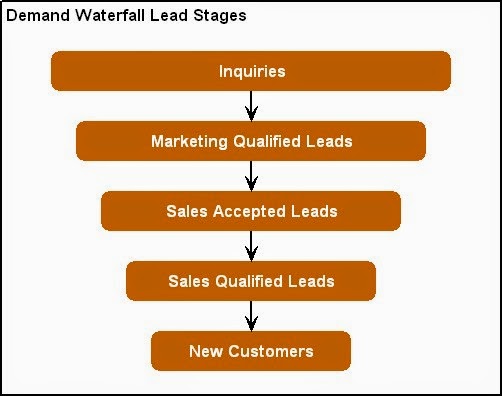
When I'm working with clients on lead generation/lead nurturing programs, I usually recommend that they use the Demand Waterfall model developed by SiriusDecisions to describe the major stages of the lead-to-revenue cycle. The graphic below shows the major components of the Demand Waterfall. SiriusDecisions recently revised the Demand Waterfall model to add several lead stages, but the framework shown below is still widely used, and I actually prefer to use the simpler version when companies are just beginning to track and measure the performance of their demand generation system.


When the topic of conversion rates comes up in conversations with clients, the question they inevitably ask is: What should our target conversion rates be? This question is always difficult to answer because conversion rates can vary greatly depending on the type of business involved, and I've never seen reliable conversion rates for specific industries or types of business. Plus, the most important thing is to determine what your current conversion rates are, and then look for ways to improve them.

While broad-based conversion rates should be used cautiously, they can provide a useful reference point. The table below shows benchmark conversion rates recently published by SiriusDecisions and the Aberdeen Group. The SiriusDecisions rates are from a 2014 presentation given by Laura Cross, a Research Director with SiriusDecisions. The Aberdeen conversion rates are from a 2014 research report titled Marketing & Sales Performance:  The Roadmap to Revenue & Its Tollgates.


This table uses the lead stage terminology from the SiriusDecisions Demand Waterfall. Aberdeen Group uses different terms for some lead stages, but I believe the table is accurate based on how Aberdeen defines lead stages.

As I noted earlier, lead conversion rates can vary significantly depending on the type of business you're in, and the conversion rates shown above may not reflect your business situation. However, they will provide a good starting point for setting your conversion rate objectives.