Today, there are two distinct, and seemingly contradictory, paradigms of B2B demand generation. Both paradigms are essentially responses to profound changes in the B2B marketing and sales environment, the most significant of which has been the emergence of empowered buyers. Business buyers now have easy access to a wealth of information, and they are using that information to perform research on their own. As a result, they are much less dependent on sellers than in the past.
One approach to dealing with empowered buyers is to expand the role of marketing in lead acquisition and lead nurturing. Proponents of this approach rely on research which indicates that today's business buyers are educating themselves and delaying conversations with sales reps until later in the buying process. For example, SiriusDecisions says that business buyers are now performing 67% of their buying process online. CEB and Forrester Research go even further and say, respectively, that B2B buyers are 57% or 67% through the buying process before they engage salespeople.
The marketing-centric paradigm accepts that most potential buyers prefer to learn about business issues and possible solutions on their own, especially in the early stages of the buying process. Advocates of the marketing-centric paradigm say that instead of fighting this preference, companies should use content resources and marketing automation technologies to support the "self-directed buyer" as he or she goes through the learning process.
The second paradigm of B2B demand generation focuses on sales methodology and emphasizes the continued importance of sales reps in the demand generation process. CEB is a major advocate of this paradigm, and what CEB and others argue is that salespeople should engage early-stage buyers and use disruptive insights to change how they are thinking about business issues and challenges. These disruptive insights enable sales reps to shape demand rather than simply react to existing demand. More importantly, disruptive insights provide value that buyers can't easily get anywhere else and thus make it worthwhile for them to interact with sales reps.
Advocates of the sales methodology paradigm argue that the statistics from SiriusDecisions, CEB, and Forrester are averages that mask a wide variation in actual buyer behavior. And there is research to support this argument. For example, in the 2012 How Buyers Consume Information Survey by ITSMA, over 70% of B2B technology buyers said that want to engage with sales reps before they finalize a short list of preferred vendors.
The reality is that B2B demand generation is more varied and complex than it is often portrayed. When you consider all of the available research, it's clear that a large majority of business buyers (probably 80% or more) are performing independent research before they interact with a sales rep. It's also clear, however, that a significant percentage of potential buyers will turn to sales reps early in the buying process. Therefore, the two paradigms of B2B demand generation are, in fact, complementary, not contradictory.
What is also undeniable is that early engagement is vital to demand generation success. Forrester says that solution providers who engage prospects early in the buying process win 74% of the deals, while the win rate for those who engage late in the process is only 26%.
The bottom line is, B2B companies must be ready, willing, and able to engage with prospects on their terms. This means that successful lead generation requires both marketing and sales.
Sunday, November 9, 2014


Sunday, November 2, 2014
Why Your Marketing Content Needs Great "Curb Appeal"
If you've ever sold a house, your real estate agent probably talked with you about the importance of curb appeal, and he or she may have suggested that you do some things (prune the landscaping, paint the trim, etc.) to improve your home's curb appeal.
Curb appeal is the visual attractiveness of a house as seen from the street, and it is what creates that all-important first impression of a house in the minds of potential buyers. Real estate professionals know that curb appeal plays a huge role in determining how quickly a house will sell and what price it will bring.
First impressions are also critical in B2B marketing. And today, most of your potential customers will base their first impression of your company on the content you publish and distribute. We now know that business buyers are performing research on their own, and many are delaying conversations with sales reps until later in the buying process. Because potential buyers usually interact with your content before they interact in any other way with your company or your product or service, they form an impression of your company based on the content they consume.
If your content fails to create a good first impression, a potential buyer will quickly look elsewhere, and you may not get another chance to create engagement with that buyer. On the other hand, when your content creates a good first impression - when it has good curb appeal - a potential buyer will likely "come back for more" and be willing to continue his or her engagement with your company. Just as important, when one of your content resources creates a good first impression, a potential buyer is much more inclined to view the rest of your content - and your company - favorably.
That's because of a powerful cognitive bias known as the halo effect. The halo effect can be defined as the transfer of positive (or negative) feelings about one thing to another, without having a rational basis for the transfer. The halo effect can be found in a wide range of human judgments. For example:
- If I meet a person who is well-spoken and likable, I am likely to believe that the person is also intelligent, generous, and ethical.
- If I have a good experience with a Honda automobile, I will be inclined to believe that I'll also be happy with a Honda lawnmower.
- If I read a white paper produced by your company and find the paper to be useful and valuable, I'll be inclined to believe that other content resources produced by your company will also be useful and valuable. Just as important, I'll also be inclined to believe that your company is good at what it does.
The critical thing to remember about the halo effect is that it elevates the importance of first impressions, sometimes to the point that subsequent information is largely ignored.
Daniel Kahneman, a winner of the Nobel Prize in economics, shared a first-hand experience with the halo effect in his best-selling book Thinking, Fast and Slow. Kahneman wrote that when he was a young professor, he graded students' essay exams in the conventional way. He picked up a test booklet and read all that student's essays in immediate succession, grading them as he went. When finished, he would compute the total grade and go on to the next student.
Kahneman eventually noticed that his evaluations of the essays in each booklet were very similar. He began to suspect that his grading exhibited a halo effect and that the first essay he scored had a disproportionate effect on the overall grade. In essence, if Kahneman gave a high score to the first essay, he tended to give that student the benefit of the doubt if the subsequent essays contained flaws.
Kahneman recognized that this created a serious problem. If a student had written two essays - one strong and one weak - Kahneman would end up awarding different final grades, depending on which essay he read first. As Kahenman writes, "I had told the students that the two essays had equal weight, but that was not true: the first one had a much greater impact on the final grade than the second."
As a B2B marketer, you can benefit from the halo effect if you consistently produce content that creates a great first impression with potential buyers. But the halo effect doesn't really make your job easier, because it's impossible to predict which of your content resources a potential buyer will encounter first. Therefore, all of your content resources need to be capable of producing great first impressions. In other words, all of your content needs to have great curb appeal.
Sunday, October 26, 2014
Is There a Crisis of Confidence in Content Marketing?
There's no longer any doubt that content marketing is playing a central role in the marketing efforts of most B2B companies. The annual content marketing surveys by the Content Marketing Institute and MarketingProfs have consistently shown that about nine out of ten B2B companies are using content marketing in some form.
Research also shows that the use of content marketing is continuing to grow.

Research also shows that the use of content marketing is continuing to grow.
- In the 2015 "B2B Content Marketing Benchmarks, Budgets, and Trends - North America" survey by CMI and MarketingProfs (the "2015 CMI survey"), 70% of respondents said they are producing more content than they did one year earlier, and 55% said they planned to increase their content marketing spending.
- In the "2014 BtoB Outlook: Marketing Priorities and Plans" study by Advertising Age, 75% of surveyed marketers said they planned to increase their content budget in 2014, and only 1.3% said they would decrease their content budget this year.
Despite their commitment to content marketing, many marketers are not satisfied with the results produced by their content marketing efforts. For example:
- In the 2015 CMI survey, only 38% of respondents said they believe their content marketing efforts have been effective.
- In another study by CMI of B2B marketers in large enterprises (companies with 1,000+ employees), only 32% of survey respondents rated their content marketing programs as effective or very effective. ("B2B Enterprise Content Marketing: 2014 Benchmarks, Budgets, and Trends - North America").
- In a July 2014 survey by Starfleet Media, 35% of respondents said they had "not been successful at all" with their content marketing efforts.
While some of this dissatisfaction undoubtedly relates to the actual performance of content marketing programs, I suggest that most of the uncertainty about content marketing exists because marketers aren't confident that they can accurately measure the business results produced by their content marketing efforts.
A 2014 survey by Contently clearly demonstrated that many marketers lack confidence in their ability to measure the business impact of content marketing. The table below shows how marketers described the effectiveness of their content-related metrics at measuring the business results produced by their content marketing programs. As the table shows, only 9.4% of surveyed marketers said they are very confident that their key performance metrics for content are effective at measuring business results. Another 45% said they are "kind of confident" in the effectiveness of their content performance metrics.
It's difficult to measure the impact of content marketing on business outcomes such as revenues because, like many marketing tactics, most content marketing activities don't directly produce immediate revenues. Despite the challenges, however, it's important for marketers to find ways to measure the value of content marketing and communicate that value to senior company leaders. Without compelling evidence that content marketing is producing significant value, the support for content marketing may begin to wane. In a future post, I'll discuss how marketers can approach the challenge of measuring the impact of content marketing.
Sunday, October 19, 2014
The Business Case for Interactive Content Marketing
It's now clear that content marketing has become a core marketing strategy for most B2B companies, and the use of content marketing is continuing to grow. Findings from the latest annual content marketing survey by the Content Marketing Institute and MarketingProfs reveal both the pervasiveness and expansion of content marketing.
The use of interactive content is not new. Some companies, primarily larger enterprises, have been using configurators, assessments, and calculators for several years. But, the interest in interactive content is growing rapidly, and the technology required to produce interactive content at scale is becoming more affordable. Therefore, the next major phase in the evolution of content marketing may well be the marketing app.
- 86% of survey respondents said their companies are using content marketing.
- 70% of respondents said they are producing more content than they did one year ago.
- 55% of respondents said they plan to increase or significantly increase their content marketing spending.
When it's done correctly, content marketing is the most effective way to create meaningful engagement with today's empowered and independent buyers. However, I suggest that we are beginning to see signs of content fatigue. The irony is that the growing popularity of content marketing is contributing to content fatigue and creating a new challenge for marketers. As more and more companies publish more and more content, it's becoming more difficult to make your content stand out.
Of course, the need to create content that captures the attention of prospects and triggers engagement is not new. In all five of the annual content marketing surveys by CMI/MarketingProfs, producing engaging content has been one of the three top challenges identified by survey respondents. The explosive proliferation of content and the resulting content fatigue have only added to the challenge.
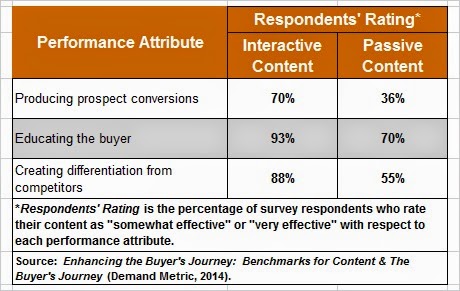
Recent research by Demand Metric reveals that interactive content can be a powerful weapon for combating content fatigue. In the Demand Metric study, interactive content was defined as content that invites or requires some level of active involvement by the prospect. The survey provided study participants several examples of interactive content, including wizards, configurators, assessments, quizzes, calculators, and games. Passive content was defined as content that invites or requires little or no interaction by the prospect beyond reading, viewing, or listening.
Demand Metric asked study participants to categorize their content using one of five options - very passive, somewhat passive, moderate, slightly interactive, or very interactive. Then, Demand Metric grouped the responses into two broader categories. The passive content category included the "very passive," "somewhat passive," and "moderate" responses, while the interactive content category included the "slightly interactive" and "very interactive" responses.
Next, Demand Metric asked survey participants to rate the effectiveness of their content at performing three critical marketing functions - producing prospect conversions, educating the buyer, and creating differentiation from competitors. Finally, Demand Metric compared the ratings of interactive content users with passive content users.
The table below shows the results of this comparison, and the results demonstrate clearly that interactive content is better than passive content at performing all three vital marketing functions.
The use of interactive content is not new. Some companies, primarily larger enterprises, have been using configurators, assessments, and calculators for several years. But, the interest in interactive content is growing rapidly, and the technology required to produce interactive content at scale is becoming more affordable. Therefore, the next major phase in the evolution of content marketing may well be the marketing app.
Sunday, October 12, 2014
Why Your Content Marketing Should Alienate (Some) Prospects
Recently, I attended a webinar presented by Doug Kessler titled Insane Honesty in Content Marketing. If you're not familiar with Doug Kessler, he's one of the co-founders of Velocity Partners, a content marketing agency based in the UK. Velocity consistently publishes great resources regarding content marketing, and this webinar is a must-see for B2B marketers.
According to Kessler, insane honesty in content marketing consists of:

Marketing content that is insanely honest serves two critical marketing objectives. It functions as a magnet that simultaneously attracts prospects who are a good fit for your business and repels those who aren't. The result is a more effective and efficient demand generation process and a lower likelihood of winding up with frustrated and unhappy customers.
According to Kessler, insane honesty in content marketing consists of:
- Actively seeking out your weaknesses and sharing them openly; and
- Strategically putting your worst foot forward.
Obviously, this approach runs counter to a whole laundry list of widely-accepted marketing principles and practices, and the idea is probably difficult for many marketers to swallow. In the webinar, Kessler shared several examples of insane honesty at work, which is another good reason you should view the presentation.
Six Reasons to Practice Insane Honesty
Six Reasons to Practice Insane Honesty
Kessler identified six reasons to practice insane honesty in your content marketing:
- It surprises and charms - Because this type of content is rare, it is more likely to capture the attention of potential buyers.
- It signals confidence - Kessler contends that confidence is the most powerful attribute of all effective content marketing.
- It builds trust - If you're insanely honest about the weaknesses of your solution, potential buyers will be more likely to trust what you say about the strengths and benefits of your solution.
- It alienates less likely buyers.
- It attracts your ideal prospects.
- It focuses your sales and marketing team on the battles you can win.
All of these reasons are important, but I want to focus on reason #4 in this post. Marketing content that is insanely honest will alienate some of your prospects, and that is a good thing because of the economics of B2B demand generation.
Insane Honesty Supports Economic Demand Generation
Insane Honesty Supports Economic Demand Generation
The diagram below illustrates the point that your investment in a prospect increases as the prospect moves through the marketing/sales funnel. On average, you will have much more invested in a Sales Opportunity than you will in an Inquiry. Therefore, it's important to determine whether your solution is a good "fit" for a prospect as early as possible in the prospect relationship.
Marketing content that is insanely honest serves two critical marketing objectives. It functions as a magnet that simultaneously attracts prospects who are a good fit for your business and repels those who aren't. The result is a more effective and efficient demand generation process and a lower likelihood of winding up with frustrated and unhappy customers.
Sunday, October 5, 2014
More Insight on the Content Preferences of B2B Buyers
DemandGen Report recently released the results of its 2014 B2B Content Preferences Survey. The 2014 survey received responses from 105 buyers of B2B products and services. It asked survey participants about their use of content in making purchasing decisions. About 38% of the survey respondents held C-level or VP-level positions at their companies, while almost 27% held director-level positions.
The results of the 2014 survey are not terribly surprising. For the most part, they are similar to the findings of DemandGen's 2013 content preferences survey, and they are also similar to the results of several other research studies, such as the 2014 B2B Technology Content Survey conducted by Eccolo Media. Still, the 2014 DemandGen survey provides several insights for B2B marketers. Here are a few of the survey's major findings:

One important takeaway from the DemandGen survey results is that white papers authored by third-party experts are still one of the most powerful and effective types of marketing content that B2B companies can use.
You can get a copy of DemandGen's 2014 B2B Content Preferences Survey report here.
The results of the 2014 survey are not terribly surprising. For the most part, they are similar to the findings of DemandGen's 2013 content preferences survey, and they are also similar to the results of several other research studies, such as the 2014 B2B Technology Content Survey conducted by Eccolo Media. Still, the 2014 DemandGen survey provides several insights for B2B marketers. Here are a few of the survey's major findings:
- Content is more important than ever - Three-fourths (75%) of survey respondents said they rely on content more than they did a year ago.
- Desktop and laptop PC's remain the primary tools for accessing business-related content, but mobile phones and tablets are growing in importance - Ninety-five percent (95%) of respondents said they frequently use a desktop or laptop PC to access content, while 56% said they frequently use a mobile phone, and 42% indicated that they frequently use a tablet.
- Buyers trust user-generated content most - Sixty-five percent (65%) of respondents said they frequently give more credence to content that includes peer reviews and user-generated feedback. Forty-three percent (43%) of respondents said they frequently trust content that is authored by a third party and sponsored by a vendor, and only 13% said they frequently give more credence to content that is created directly by a vendor.
The authors of the DemandGen survey report noted that the popularity of white papers fell by 5% in 2014. However, the survey also revealed that B2B buyers still rate white papers as the most valuable type of content. The 2014 survey included this question: "What do you feel are the most valuable online content formats for researching B2B purchases? (rate on a scale of 1 to 5 with 1 = most effective)" The table below shows the percentage or respondents giving each content format a "1" rating.
One important takeaway from the DemandGen survey results is that white papers authored by third-party experts are still one of the most powerful and effective types of marketing content that B2B companies can use.
You can get a copy of DemandGen's 2014 B2B Content Preferences Survey report here.
Sunday, September 28, 2014
Marketing Strategy is Vital - Marketing Plans are (Nearly) Worthless
Most business leaders now agree that today's competitive environment is more volatile, uncertain, and complex than ever before, and that companies must constantly adapt in order to grow and prosper. While volatility, uncertainty, and complexity affect all aspects of business, they are having a profound impact on marketing. The interests, values, and preferences of today's consumers and business buyers can change rapidly, and marketers must be ready to respond quickly to these changes.
Marketing leaders now recognize that the explosive pace of change in the marketing landscape has made flexibility and agility critical attributes of effective marketing. The need for adaptable and responsive marketing has caused some pundits and practitioners to question whether a long-term, strategic approach to marketing is still useful. In addition, it can be easy to argue that the growing use of agile marketing techniques eliminates the need for (or at least diminishes the value of) marketing strategy. The fundamental issue is: Is marketing strategy still necessary and valuable when the recipe for effective marketing seems to be constantly changing?
The argument that marketing strategy no longer matters goes something like this: "The future is inherently unpredictable, so why worry about a marketing strategy? Why spend the time developing a marketing strategy when competitive conditions are just going to change anyway, and there's no way to be certain that any given strategy will be relevant in the future? What companies should do is focus on reacting quickly to changes as they occur."
On the surface, this argument sounds reasonable, but it is deeply flawed. The reality is, increased volatility, uncertainty, and complexity make marketing strategy more, not less, important. Many marketers find the argument appealing because they confuse marketing strategy with marketing plans.
Marketing Plans Focus on Tactics
Over the past twenty-five years, I've reviewed dozens of marketing plans, and I've found that they inevitably emphasize marketing tactics, specifically marketing communication tactics. For example, a marketing plan will typically describe where and how much TV, radio, and print advertising will be used, what direct marketing campaigns will be run, and how marketers plan to leverage social media marketing. In B2B companies, the marketing plan will also identify the trade shows and other events the company will participate in. In short, marketing plans talk a lot about marketing tactics, but give little attention to marketing strategy.
Marketing Strategy Deals with Different Issues
Strategy has been defined in a multitude of ways over the years. Roger Martin, former Dean of the Rotman School of Management and co-author of Playing to Win: How Strategy Really Works, provides a definition that captures the essence of strategy pretty well. In his book, Martin says that strategy is a set of choices that provide the answers to five questions:
- What is our winning aspiration (what does success look like)?
- Where will we play (what kinds of organizations and/or individuals will we seek to serve, what products and/or services will we offer, and where, geographically, will we compete)?
- How will we win (how will we create value for our customers)?
- What capabilities need to be in place?
- What management systems must be instituted?
These five questions relate to overall business strategy, but with a few slight modifications, they can easily be used to define the essential components of marketing strategy.
Strategy and Tactics Have Different Shelf Lives
It should be obvious that marketing strategy and marketing tactics deal with very different issues. Just as important, marketers must remember that strategy and tactics have different shelf lives.
Marketing strategy focuses (or should focus) primarily on what kinds of organizations or people your company will seek to serve and on how you will create value for those customers. These choices do not change all that frequently, even in today's volatile environment. Marketing tactics, on the other hand, can and should be constantly adapted to address changing buyer interests, concerns, and communication preferences. The tactics that work well today, may be far less effective in a few weeks or months.
Marketing strategy guides and provides the context for your tactical marketing activities. That makes marketing strategy vital for effective marketing. Marketing tactics must be constantly tweaked in response to future conditions that are inherently unpredictable. That makes marketing plans that extend for more than a few weeks into the future almost worthless.
Subscribe to:
Posts (Atom)

 Posts