Sunday, September 28, 2014

Marketing Strategy is Vital - Marketing Plans are (Nearly) Worthless

Most business leaders now agree that today's competitive environment is more volatile, uncertain, and complex than ever before, and that companies must constantly adapt in order to grow and prosper. While volatility, uncertainty, and complexity affect all aspects of business, they are having a profound impact on marketing. The interests, values, and preferences of today's consumers and business buyers can change rapidly, and marketers must be ready to respond quickly to these changes.

Marketing leaders now recognize that the explosive pace of change in the marketing landscape has made flexibility and agility critical attributes of effective marketing. The need for adaptable and responsive marketing has caused some pundits and practitioners to question whether a long-term, strategic approach to marketing is still useful. In addition, it can be easy to argue that the growing use of agile marketing techniques eliminates the need for (or at least diminishes the value of) marketing strategy. The fundamental issue is:  Is marketing strategy still necessary and valuable when the recipe for effective marketing seems to be constantly changing?

The argument that marketing strategy no longer matters goes something like this:  "The future is inherently unpredictable, so why worry about a marketing strategy? Why spend the time developing a marketing strategy when competitive conditions are just going to change anyway, and there's no way to be certain that any given strategy will be relevant in the future? What companies should do is focus on reacting quickly to changes as they occur."

On the surface, this argument sounds reasonable, but it is deeply flawed. The reality is, increased volatility, uncertainty, and complexity make marketing strategy more, not less, important. Many marketers find the argument appealing because they confuse marketing strategy with marketing plans.

Marketing Plans Focus on Tactics

Over the past twenty-five years, I've reviewed dozens of marketing plans, and I've found that they inevitably emphasize marketing tactics, specifically marketing communication tactics. For example, a marketing plan will typically describe where and how much TV, radio, and print advertising will be used, what direct marketing campaigns will be run, and how marketers plan to leverage social media marketing. In B2B companies, the marketing plan will also identify the trade shows and other events the company will participate in. In short, marketing plans talk a lot about marketing tactics, but give little attention to marketing strategy.

Marketing Strategy Deals with Different Issues

Strategy has been defined in a multitude of ways over the years. Roger Martin, former Dean of the Rotman School of Management and co-author of Playing to Win:  How Strategy Really Works, provides a definition that captures the essence of strategy pretty well. In his book, Martin says that strategy is a set of choices that provide the answers to five questions:

  • What is our winning aspiration (what does success look like)?
  • Where will we play (what kinds of organizations and/or individuals will we seek to serve, what products and/or services will we offer, and where, geographically, will we compete)?
  • How will we win (how will we create value for our customers)?
  • What capabilities need to be in place?
  • What management systems must be instituted?
These five questions relate to overall business strategy, but with a few slight modifications, they can easily be used to define the essential components of marketing strategy.

Strategy and Tactics Have Different Shelf Lives

It should be obvious that marketing strategy and marketing tactics deal with very different issues. Just as important, marketers must remember that strategy and tactics have different shelf lives.

Marketing strategy focuses (or should focus) primarily on what kinds of organizations or people your company will seek to serve and on how you will create value for those customers. These choices do not change all that frequently, even in today's volatile environment. Marketing tactics, on the other hand, can and should be constantly adapted to address changing buyer interests, concerns, and communication preferences. The tactics that work well today, may be far less effective in a few weeks or months.

Marketing strategy guides and provides the context for your tactical marketing activities. That makes marketing strategy vital for effective marketing. Marketing tactics must be constantly tweaked in response to future conditions that are inherently unpredictable. That makes marketing plans that extend for more than a few weeks into the future almost worthless.

Sunday, September 21, 2014

How Agile Marketing Improves Business Performance

Most marketers now recognize that flexibility, adaptability, and responsiveness have become critical attributes of successful marketing. The interests, values, and communications preferences of today's buyers can all change rapidly, and marketers must always be prepared to deal with a competitive environment that's constantly evolving.

Marketers no longer have the luxury to spend months crafting large marketing campaigns and programs that are designed to run for weeks or months. In today's fast-paced, always-on marketing environment, marketers must be able to produce on the fly, and continuously adapt their marketing tactics and content to changing competitive conditions.

The demand for more adaptable and responsive marketing has given birth to a new marketing discipline that's known appropriately as agile marketing. Agile marketing is derived from agile software development. It's based on several principles, but the primary focus is on rapid prototyping, small-scale experimentation, and breaking marketing activities into small tasks that can be completed in a relatively short period of time (a week or a few weeks at most).

Over the past couple of years, a growing number of companies have implemented agile marketing in some form, and recent research has demonstrated that agile marketing produces significant benefits. For example, CMG Partners recently released the results of a qualitative survey that involved interviews with more than 40 CMO's, other marketing leaders, and agile marketing experts. The survey included both respondents from companies that had implemented agile marketing ("agile users") and respondents that had not yet adopted agile marketing ("non-users").

The results of the CMG Partners research clearly show that agile marketing drives improved business performance. For example:

  • 88% of non-users said that improving speed to market is a priority, while 93% of agile users said that adopting agile marketing had helped them to improve time to market (in terms of ideas, products, or marketing campaigns).
  • 91% of non-users said that being able to change direction more quickly and effectively is a priority, while 93% of agile users said that agile marketing helped them to change marketing messages and tactics more quickly and effectively.
  • 96% of non-users said that improving the productivity of their marketing team is a priority, while 87% of agile users said that implementing agile marketing had made their team more productive.
Some readers may wonder whether agile marketing is compatible with a longer-term strategic approach to marketing. Given the focus on short-term projects, small-scale experiments, and the use of feedback loops to drive frequent iterations of marketing programs, it would be easy to conclude that agile marketing eliminates the need for (or at least diminishes the value of) marketing strategy.

This is an important issue that I'll address in a future post. For now, let me just say that a well-conceived marketing strategy is critical for effective agile marketing because the strategy provides the essential context for agile marketing activities.

What's not open to debate is that marketing must be flexible and adaptable to succeed in today's volatile environment.

For a great introduction to agile marketing, take a look at this presentation made by Scott Brinker, a co-founder and the CTO of ion interactive, inc. Scott is also the author and editor of the Chief Marketing Technologist blog, which I strongly recommend that you read regularly.

For more about the CMG Partners research, read this article at Forbes.

Sunday, September 14, 2014

Stop Looking for "Silver-Bullet" Solutions in Marketing

In the sixteenth century, Spanish conquistadors in South America heard stories about a king who made an offering of gold and precious gems to his god as part of a religious ceremony. The Spaniards called the king El Dorado, and over time El Dorado came to mean the city of this king. According to the legend, El Dorado contained gold and precious stones in fabulous abundance. The legend was so powerful that for over two centuries, European explorers mounted numerous expeditions to search for El Dorado.

So far as we know, the "city of gold" was never found.

It's only human to long for simple and easy solutions to complex or difficult problems. At least once in our lives, most of us have yearned for a magic diet pill that would enable us to lose twenty pounds in four weeks without eating less or exercising more. Usually, we know this is just wishful thinking, but in some cases, our desire for simple solutions rises above mere wishful thinking. The number of self-help books that are sold every year demonstrates that millions of us are willing to believe that simple solutions for difficult challenges do, or at least might, exist.

The desire for simple solutions can also be found in the business world. Nowhere is this more evident than in the attempt to answer the most basic of all business questions:  What drives high performance? Over the past few decades, the effort to describe the "secret sauce" for achieving high performance has probably consumed more brainpower than any other single business topic. It has been the modern-day business equivalent of the quest for the Holy Grail or the search for El Dorado.

Since the early 1980s, dozens of books - most written by talented and well-respected authors - have purported to explain how companies achieve high performance. Some of these books describe the important attributes that high-performing companies share. The implicit (and often explicit) promise is that if you can develop these attributes in your business, you too will achieve high performance. Other books focus on specific management tools or techniques. Once again, the implicit promise is:  Use this tool or technique, and high performance will inevitably follow.

Despite the best efforts of a lot of very smart people, the recipe for high performance has remained elusive. No one has been able to get it quite right.

The desire for "silver-bullet" solutions is also widespread in the marketing world. Over the past few years, the number of marketing channels and techniques has exploded, largely because of the evolution of digital communication technologies. When a promising new marketing channel or technique appears, the marketing community often responds with great excitement. The "shiny new object" becomes the topic du jour for articles, blog posts, webinars, conference sessions, and even full-length books. As the hype machine kicks in, it becomes almost impossible not to overestimate the value that the new channel or technique will provide.

The basic problem is that success in marketing is far more complex and unpredictable than most people like to admit. The marketing world is not ruled by the kinds of precise laws that govern the natural world. For example, if I apply heat to water, the water will boil when the temperature reaches 212 degrees Fahrenheit. I can repeat this "experiment" thousands of times, and the result will always be the same. The laws of physics enable me to accurately predict that my action (applying heat to water) will produce a specific outcome (boiling water).

This level of predictability simply doesn't exist when it comes to marketing performance because success in marketing is determined by the interplay of numerous factors, many of which are beyond our control. The inability to dictate future outcomes has two important implications for marketers. First, it means that the use of any marketing tool or technique won't guarantee high performance, regardless of how sound that tool or technique may be. More importantly, however, we can't dictate future outcomes because there is no universal formula for high performance in marketing. Like El Dorado, it just doesn't exist.

Uncertainty will always be a prominent feature in the marketing landscape. When we accept the inevitability of uncertainty, we can put the decisions we make on sounder footing. This approach may not provide us as much comfort as relying on simple, "silver-bullet" solutions, but it's better than wasting our time on a fruitless search for El Dorado.

Sunday, September 7, 2014

Diagnosing the Performance of Your Demand Generation Funnel

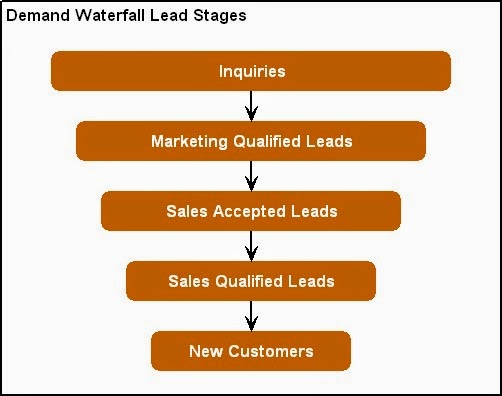
If you're a B2B marketer, describing the major attributes of your lead-to-revenue funnel and measuring the dynamics of your funnel are critical to understanding how well your demand generation system is performing. Funnel metrics will help provide the answers to three important questions:

  • Volume - Are our marketing programs generating a sufficient number of raw leads (sometimes called inquiries or engaged contacts or responses) to produce the amount of revenue that marketing is responsible for?
  • Conversion - What percentage of leads are progressing or "converting" from each lead stage to the next across the entire lead-to-revenue cycle?
  • Velocity - How long is the overall revenue cycle? In other words, how much time does it take, on average, for an initial response or inquiry to result in a closed sales? Funnel metrics can also measure how long, on average, leads spend in each stage of the lead-to-revenue cycle.
When I'm working with clients on lead generation/lead nurturing programs, I usually recommend that they use the Demand Waterfall model developed by SiriusDecisions to describe the major stages of the lead-to-revenue cycle. The graphic below shows the major components of the Demand Waterfall. SiriusDecisions recently revised the Demand Waterfall model to add several lead stages, but the framework shown below is still widely used, and I actually prefer to use the simpler version when companies are just beginning to track and measure the performance of their demand generation system.


When the topic of conversion rates comes up in conversations with clients, the question they inevitably ask is: What should our target conversion rates be? This question is always difficult to answer because conversion rates can vary greatly depending on the type of business involved, and I've never seen reliable conversion rates for specific industries or types of business. Plus, the most important thing is to determine what your current conversion rates are, and then look for ways to improve them.

While broad-based conversion rates should be used cautiously, they can provide a useful reference point. The table below shows benchmark conversion rates recently published by SiriusDecisions and the Aberdeen Group. The SiriusDecisions rates are from a 2014 presentation given by Laura Cross, a Research Director with SiriusDecisions. The Aberdeen conversion rates are from a 2014 research report titled Marketing & Sales Performance:  The Roadmap to Revenue & Its Tollgates.


This table uses the lead stage terminology from the SiriusDecisions Demand Waterfall. Aberdeen Group uses different terms for some lead stages, but I believe the table is accurate based on how Aberdeen defines lead stages.

As I noted earlier, lead conversion rates can vary significantly depending on the type of business you're in, and the conversion rates shown above may not reflect your business situation. However, they will provide a good starting point for setting your conversion rate objectives.

Sunday, August 31, 2014

How Media Consumption Statistics Can Mislead Marketers

Earlier this year, eMarketer published a new estimate of the amount of time US adults (ages 18+) spend with various types of media. Like many media analysts, eMarketer estimates that the amount of time spent with mobile media is growing more rapidly than all other forms of media consumption, while the consumption of print media continues to decline precipitously.

eMarketer also estimated the amount of advertising spending per hour of time spent with each type of media, and the table below contains some of the eMarketer estimates. As the table shows, eMarketer is projecting that this year, advertisers will spend 7 cents for every hour a US adult spends consuming mobile media, but more than 10 times that amount (83 cents) for every hour spent consuming print media (magazines and newspapers).


eMarketer isn't the only analyst to make this kind of consumption vs. spending comparison. In the 2013 edition of her widely-acclaimed annual presentation on Internet trends, Mary Meeker also compared the time spent consuming various types of media with advertising spending. The table below shows the data she presented, and her statistics also reveal significant disconnects between the time spent with print and mobile, and the amount of advertising spending devoted to those channels.


So, what's the point of these comparisons? The argument made by some is that advertising and marketing spending should reflect media consumption patterns. If you buy into this argument, then the above data would indicate that companies are over-investing in print advertising and under-investing in mobile advertising.

Understanding media consumption patterns is obviously important for effective marketing, but marketers shouldn't rely too much on high-level media consumption data for three reasons.

First, broad consumption patterns usually aren't specific enough to provide effective guidance for an individual company. As an enterprise marketer, what you really need to know is how the prospective buyers in your target market consume media. For example, Mary Meeker's data says that US adults spend only 6% of their total media consumption time on print media, but prospective buyers in your target market may spend considerably more of their time with print.

Second, the consumption data discussed above is restrictive. It only compares advertising spending to media consumption time. Numerous research studies have shown that spending on digital marketing has grown explosively over the past several years. Therefore, if the above data included all marketing spending, the comparisons would look substantially different.

Finally, the time people spend with a particular type of media isn't necessarily indicative of how effective that channel will be as a marketing tool. For example, many younger B2B buyers may spend a considerable amount of time using mobile devices for a variety of reasons, but that may not be the primary way they access business-related information. The fallacy is to assume that personal communications preferences and marketing communications preferences are identical.

The 2012 Channel Preferences Survey by ExactTarget found that personal communications habits are not a good indicator for marketers who are looking for the best way to communicate with potential buyers. As the authors of the survey report wrote, "The lesson here for marketers is that just because consumers embrace a channel for personal communications doesn't mean that they want to receive direct marketing messages from your brand via that channel." To improve the effectiveness of your marketing, you need to understand how your prospective buyers prefer to receive marketing messages.

The bottom line? Media consumption patterns are interesting, and they can be somewhat useful. But you need to know more to make sound marketing decisions.

Sunday, August 24, 2014

Why Expert Content Should Be Part of Your Content Marketing Mix

About a year ago, I started to rethink my views regarding the role and value of third-party content in the marketing efforts of B2B companies. I had always believed that most of the marketing content used by a company should be developed internally or with the help of outside professional content developers. In either case, the "authorship" of the content is attributed to the company or to a company executive or internal subject matter expert. With third-party content, an external person or firm creates the content and is identified as the author.

My preference for "vendor-branded" content was based on the idea that a primary objective of content marketing is to communicate your company's expertise to potential buyers and thus cause those buyers to view your company as a trusted resource for valuable insights and as a capable business partner. Logically, branded content seemed to be the most direct way to accomplish this objective.

Because of three recent research studies, I now have a different view on this issue.

The 2013 Research

Last year, the CMO Council published a white paper - Better Lead Yield in the Content Marketing Field - that was based on a survey of more than 400 B2B content consumers. As the table below shows, survey respondents said they trust and value several kinds of third-party content more than vendor-created content.


The 2013 B2B Content Preferences Survey by DemandGen Report showed similar results. In this survey, B2B buyers were asked which of four types of content they give more credence to. The table below shows that vendor-branded content doesn't fare as well as third-party content.


The 2014 Research

The results of a third study published in March of this year provides even more compelling evidence regarding the effectiveness of "expert content." This research was commissioned by inPowered and conducted by The Nielsen Company. The Nielsen study involved 900 participants and consisted of a proctored, in-laboratory experiment combined with both a pre-experiment and a post-experiment survey.

During the in-laboratory portion of the study, participants were exposed to three types of marketing content pertaining to several types of products having a wide range of price points. Expert content included reviews and articles from third-party websites and blogs. User reviews were selected from the websites of major retailers or other online forums. Branded content consisted of content that was taken from the vendor's website.

The Nielsen study measured the impact of each type of content on three stages of the purchase decision-making process:

  • Familiarity with a new product
  • Affinity toward a brand or product
  • Purchase consideration of a brand or product
The results of the Nielsen study clearly demonstrate that expert content is the most effective type of marketing content in terms of impacting consumers across the entire purchase cycle. Expert content lifted familiarity 88% more than branded content, it lifted affinity 50% more than branded content, and it lifted purchase consideration 38% more than branded content. While the Nielsen study involved consumer products, it is likely that the results would be similar in a B2B setting.

It's clear from these research studies that potential buyers are inclined to trust third-party content (particularly expert content) more than content created by potential vendors, and B2B marketers should take advantage of this inclination. Content authored by a third-party expert and sponsored by your company can be a highly effective marketing tool. So, I'm now convinced that expert content should be an integral part of the content marketing mix at most B2B companies.

Sunday, August 17, 2014

How to Close the Performance Gap in Lead Generation and Content Marketing

Over the past few years, both lead generation and content marketing have become primary focus areas for B2B marketers. Because of changes in how B2B buyers are learning about business issues and possible solutions, marketers have been required to assume greater responsibility for acquiring and nurturing sales leads. Meanwhile, most B2B marketers now recognize that content marketing is the most effective way to create and maintain meaningful engagement with potential buyers.

Despite all of the recent focus on lead generation and content marketing, research indicates that companies vary significantly in terms of how well they are performing these critical marketing functions. Some companies excel at lead generation and content marketing, while others aren't doing nearly as well.

Last fall, the Content Marketing Institute and MarketingProfs published the results of their latest annual content marketing survey. In that survey, 93% of B2B respondents said they are using content marketing, but only 42% of respondents said their content marketing programs are effective.

Earlier this year, Demand Metric published the results of a lead generation benchmark survey. In that survey, 89% of respondents said their companies have a lead generation process, but only half of the respondents (49%) rated their lead generation efforts as moderately or highly effective.

The Demand Metric survey found that the three most widely used lead generation techniques were e-mail, tradeshow/event marketing, and content marketing. Demand Metric also found that the top three lead generation techniques were the same regardless of company size or whether a company was growing or experiencing declining revenues, and regardless of how respondents from the company rated the effectiveness of their lead generation process.

In other words, Demand Metric found that everyone is essentially using the same lead generation techniques, but some companies are achieving better results than others. The logical conclusion is that lead generation effectiveness is not a function of which techniques are used, but how those techniques are planned and executed.

So, what attributes and practices separate companies with high-performing lead generation and content marketing programs from those whose programs are less effective? The CMI/MarketingProfs research provides insights on this important issue.

CMI and MarketingProfs compared several attributes of highly-effective content marketers with less effective content marketers. Highly-effective content marketers were survey respondents who rated the effectiveness of their organization's use of content marketing as 4 or 5 (on a scale of 1 to 5, with 5 being "Very Effective"). Less effective marketers were those respondents who rated the effectiveness of their organization's use of content marketing as 1 or 2 (with 1 being "Not At All Effective"). The table below shows the results of this comparison.


As this table shows, companies with highly-effective content marketing programs are more likely to:
  • Have a documented content marketing strategy
  • Have someone with specific responsibility for overseeing and managing the content marketing program
  • Devote sufficient financial resources to their content marketing program
While the CMI/MarketingProfs survey dealt specifically with content marketing, these attributes are equally applicable to lead generation. To have a highly-effective lead generation program, you need a well-conceived and documented lead generation strategy, someone dedicated to managing your lead generation efforts, and sufficient financial resources to support an effective lead generation program.