Sunday, February 27, 2022

[Deep Dive] For Better Marketing Measurement - Draw a Map


Image Source:  Shutterstock

Key Takeaways

Marketing leaders are facing constant demands to improve marketing performance and prove the business value of marketing activities. To meet these demands, marketing leaders need an effective marketing measurement system, but measuring marketing performance has been a perplexing challenge for decades, and it remains a significant issue today.

In this article, we'll explain - 

  • Why the key to building a robust marketing measurement system is to tie the system to your marketing strategy
  • How to use a marketing strategy map to describe your strategy in measurable terms and link your marketing activities to business value
Marketing Measurement is Still a Challenge
The persistent and growing demands for greater accountability from marketing has resulted in a huge volume of literature describing how to measure marketing performance. Marketing industry pundits have addressed the topic from almost every conceivable angle in dozens of ebooks, white papers, articles and presentations.
Despite all this attention, recent research indicates that many marketers aren't satisfied with their marketing performance measurement system. In the 2021 Marketing Measurement & Attribution Survey by Demand Gen Report, 58% of B2B marketing executives said their company's ability to measure and analyze marketing performance is poor/inadequate or needs improvement.
Marketers attribute their dissatisfaction to a variety of specific factors, including data and technology issues. But it's increasingly apparent that many marketers need to take a fresh look at how they're approaching the task of measuring marketing's performance and value.
The Key to Meaningful Marketing Measurement
The key to building an effective marketing measurement system is to tie the system directly to the company's marketing strategy. In other words, the measurement system should be designed to measure how well the marketing strategy is working. That's because the performance of marketing and its ability to add value to the business are largely dependent on the quality and execution of the marketing strategy.
Deriving marketing metrics from marketing strategy is also the right approach because a company's marketing strategy is ultimately defined by what marketing activities it chooses to perform, how it chooses to perform those activities, and how those activities relate to and reinforce one another. Therefore, marketing activities are the building blocks of marketing strategy, and marketing strategy is the essential connective tissue that links marketing activities to business value.
This approach has several implications for marketing leaders. Most importantly, it means they will need to describe their marketing strategy in measurable terms before they select specific marketing metrics.
The Architecture of a Marketing Strategy Map
The best tool for describing a company's marketing strategy in measurable terms is a marketing strategy map. A strategy map is simply a diagram that depicts the marketing objectives and activities that constitute the major elements of a company's marketing strategy.
These objectives and activities are arranged in a hierarchy of linked cause-and-effect relationships. A marketing strategy map makes these relationships and dependencies visible, and therefore it will enable marketing leaders to measure how well their strategy is working.
In this post, I'll describe the basic architecture of a marketing strategy map. Every company's strategy map will be unique because every company's marketing strategy is unique. In this discussion, I'll cover components that appear in most marketing strategy maps, and I'll use others for illustrative purposes.
To keep the length of this post manageable, my discussion will focus on a vertical "slice" of a complete marketing strategy map. This will allow me to describe the full "depth" of a strategy map and demonstrate how it enables marketing leaders to connect marketing activities to strategic business outcomes.
The most effective way to build a marketing strategy map is to use a top-down approach. In virtually all companies, the ultimate goal of marketing is to create value for the enterprise, so that objective is placed at the top of the strategy map, as shown in the following diagram.
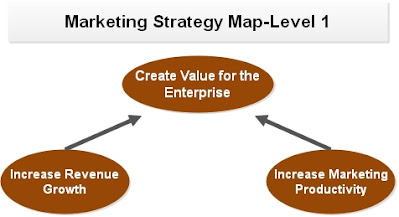


Marketing can create value for the enterprise in two basic ways - by driving revenue growth and by increasing the productivity of the marketing function. A sound marketing strategy will seek to create value in both ways. Therefore, most marketing strategy maps will include both a revenue growth objective and a marketing productivity objective, as the diagram shows.
A marketing strategy map also makes the "logic" of the strategy clear. In the above diagram, the directional arrows indicate that the hypothesis of the strategy is that marketing will create value for the enterprise if it drives revenue growth and improves marketing productivity.
Most marketers will use return on marketing investment to measure marketing's contribution to the value of the enterprise. Revenue growth is often measured using the year-over-year percentage growth rate. Marketing productivity can be measured in several ways, but one of the better metrics is the revenue turnover ratio. This ratio is calculated by dividing total annual revenue by total annual marketing costs.
The balance of this post will focus on the revenue growth side of a marketing strategy map, part of which is depicted in the following diagram.


Virtually all companies have access to four structural sources of organic revenue growth.
  1. Continuing sales to existing customers (customer retention)
  2. Increased sales to existing customers
  3. Sales to new customers in existing markets
  4. Sales to new customers in new markets
The marketing strategies of most companies will include objectives for most, if not all, of these sources of revenue growth, as the above diagram illustrates.
Marketers can use a variety of metrics to measure their success at achieving these revenue growth objectives. For example:
  • For continuing sales to existing customers - annual customer churn rate
  • For increased sales to existing customers - share of wallet (in the relevant category)
  • For sales to new customers in existing markets - 
    • Number of new customers acquired in existing markets
    • Revenue from new customers acquired in existing markets
  • For sales to new customers in new markets - 
    • Number of new customers acquired in new markets
    • Revenue from new customers acquired in new markets
Once again, a marketing strategy map uses directional arrows to make the logic of the marketing strategy clear. If marketing successfully drives revenue from a combination of these growth sources, it will achieve its overall revenue growth objective.
It's important to make three points concerning the four revenue growth objectives shown above. First, some marketing leaders will use more specific versions of these growth objectives if their marketing strategy is more targeted. For example, if company leaders believe that acquiring new customers in certain industry sectors is an attractive growth opportunity, marketing leaders may use objectives and metrics that are specific to those industry sectors.
Second, marketing leaders will place different priorities on these four growth objectives based on the market and competitive conditions their company is facing. And third, some marketing leaders may not use all four growth objectives. For example, some companies may have no current plans to enter a new market.
The marketing objectives I've discussed so far would be appropriate for most companies. The remaining objectives will be more company specific because they are dependent on what a company sells, the attributes of the buying process used by the company's prospects and customers, and the specific marketing tactics the company plans to use.
The following diagram shows an illustrative set of marketing objectives that relate specifically to one of the growth objectives previously discussed - acquiring new customers in existing markets.


The marketing strategy depicted in this diagram is focused on three objectives - increasing brand awareness, increasing the level of buyer engagement, and increasing the number of qualified sales opportunities. The logic of this strategy can be described as follows:
  • Increasing brand awareness will result in an increased level of buyer engagement with the company.
  • Increasing buyer engagement will increase the number of qualified sales opportunities available to the company.
  • Increasing the number of sales opportunities will increase the number of new customers the company acquires and increase revenue from new customers
The final component of a marketing strategy map is a description of the types of activities marketing leaders will implement to achieve the identified objectives. Each marketing activity is linked to the objective or objectives marketing leaders believe the activity will impact.
For this discussion, I'm using one marketing activity - blogging - to illustrate how to address marketing activities in a strategy map. In the above diagram, blogging is designed to increase brand awareness and to increase buyer engagement. The logic of marketing leaders would be:  If we increase the quantity and quality of the content published at our blog, we will increase the awareness of our company and/or brand by potential buyers, and we will also increase engagement by potential buyers.
Marketers can use several metrics to measure brand awareness and buyer engagement. Some examples are:
  • For brand awareness - 
    • Share of search
    • Brand health surveys
  • For buyer engagement  - 
    • Number of website visitors
    • Number of content views/downloads
    • Time spent with website content
Marketers also have several options for measuring the specific performance of their blog. These could include number of pageviews and shares of blog content on social media.
Of course, marketing leaders will implement other types of marketing programs to drive increased brand awareness and increased buyer engagement. A complete marketing strategy map will include all of the types of marketing activities that are part of the marketing strategy, and those activities will be linked to one or more marketing objectives.
The Most Important Benefit of a Marketing Strategy Map
A marketing strategy map provides several benefits, but the greatest benefit is that it helps marketing leaders solve one of the most difficult challenges associated with marketing performance measurement.
 Marketing creates business value through activities that operate at different stages of the value creation process. The problem is, many marketing activities contribute to business value only indirectly, and some will be several steps removed from the economic outcomes they affect. Under these circumstances, it's difficult for marketing leaders to show the financial value of such "remote" marketing activities.
When marketing leaders build a strategy map, they create a chain of linked marketing activities and objectives that makes it possible to connect marketing programs to top-level business outcomes in measurable ways.
The following diagram illustrates how a marketing strategy map can be used to prove the value of a "remote" marketing activity, in this case blogging.


It would be very difficult to prove that blogging has an impact on enterprise value because the direct relationship (the correlation) between blogging activity and changes in business value is weak. The diagram uses a thin dotted line to depict this weak relationship.
However, the marketing strategy described in this post is based on the hypothesis that publishing a high-quality blog will increase brand awareness and buyer engagement. The relationships between blogging activity and both increased brand awareness and increased buyer engagement are direct and can be measured. So, if the hypothesis of the strategy is valid, improving the quality of blog content will result in greater brand awareness and buyer engagement.
The marketing strategy depicted in the diagram is also based on the hypothesis that increasing brand awareness and buyer engagement will result in more sales opportunities, which will result in more sales to new customers, which will lead to overall revenue growth. And revenue growth will create value for the enterprise.
The relationships among the adjacent marketing objectives shown in the above diagram can all be measured quantitatively, which enables the hypothesis of the strategy to be tested and validated.
The bottom line is, the chain of linked marketing activities and objectives in a marketing strategy map enables marketing leaders to test the effectiveness of their marketing strategy and to demonstrate the indirect impact of marketing activities on business outcomes and value.

Sunday, February 20, 2022

The "Head Start" B2B Marketers Can't Afford to Ignore


Imagine you are a talented track athlete who is about to run a 100-yard dash. Your competitors are all capable athletes, but you'll have a major advantage in the race because you'll be given a 20-yard head start. Under these circumstances, I think most of us would feel confident about our chances of winning.

In the race to win new sales and grow revenues, some companies have a significant "head start" over others. Astute B2C marketers have long recognized the value of this head start, but many B2B marketers don't fully appreciate the advantage it creates. And unfortunately, many of the currently popular B2B marketing practices and techniques largely ignore it.

I'm referring to the head start that results when a company or a brand or a product is included in a potential buyer's initial consideration set for a prospective purchase. In marketing parlance, the consideration set is just what it sounds like - it's the group of companies, brands or products that a potential buyer considers when evaluating a possible purchase.

The initial consideration set is composed of those companies, brands or products that come into the mind of a potential buyer before an intentional buying process actually begins. The importance of the initial consideration set becomes clear when we examine how people (both consumers and business buyers) make buying decisions.

The McKinsey Consumer Decision Journey Model

Several years ago, McKinsey & Company introduced a new model of the consumer decision journey, which is shown in the following diagram.

Source:  McKinsey & Company

In McKinsey's model, a consumer decision journey begins when an event or condition triggers a perceived need or desire to potentially buy something. When a trigger occurs, most consumers will quickly create a mental list of companies or brands or products they believe are worth considering.

This initial consideration set is based on the mental impressions they have formed from a variety of touch points such as their experiences with a company, brand or product, advertisements, content resources, news reports and conversations with family, colleagues and friends.

The next step in the decision journey is an active evaluation process, during which consumers gather information about potential solutions and may add or remove companies, brands or products from their consideration set. At the conclusion of this evaluation process, consumers select a product or service to buy, or they may decide not to buy anything.

The main point here is that most consumers create their initial consideration set before they begin their intentional buying process.

Research by McKinsey has shown that being included in a potential buyer's initial consideration set can produce a significant advantage for B2C companies. The firm found that brands in the initial consideration set are more than two times as likely to be purchased as brands that aren't in it.

Does This Apply In B2B?

McKinsey's decision model focuses on consumer buying decisions, but there are several reasons to believe the decision making process in B2B is similar. For one thing, it's likely that most business buyers are generally aware of the major companies or brands offering products or services that are relevant to their jobs. Therefore, when something triggers a perceived need to buy something for their company, many business buyers will find it easy to identify an initial consideration set of potential vendors.

McKinsey's research on the impact of being (or not being) in a potential buyer's initial consideration set was also focused on B2C buying decisions. And while I'm not aware of any directly comparable research in the B2B space, several studies suggest that B2B is similar to B2C.

The WSJ Intelligence/B2B International Survey

For example, in a 2021 survey of business decision makers by WSJ Intelligence and B2B International, the researchers divided the B2B customer decision journey into three stages - Pre-Decision, Search, Evaluation, and Shortlisting, and Final Decision.

The study defined the Pre-Decision stage as " . . . the time between when they had selected a supplier for the given [purchase] category and when the 'trigger' occurred that prompted them to actively begin searching for and deciding on a new supplier."

This survey contained several questions about a recent purchase decision and asked survey participants to reflect on the vendor that was ultimately selected (the "winning vendor") and on a vendor that was considered but not selected (the "losing vendor").

The findings of this study clearly demonstrate that familiarity and emotional connections that exist at the Pre-Decision stage have a significant impact on purchase decisions. Survey respondents were more than twice as likely (79% vs. 33%) to report they were very familiar with the winning vendor versus the losing vendor before their active buying process began.

The survey results also showed that at the Pre-Decision stage, respondents had a higher level of pre-existing trust (57% vs. 37%) and confidence (52% vs. 37%) in the winning vendor than in the losing vendor. 

One of the more interesting findings in this research was the small number of potential vendors that were included in the initial consideration set for most potential purchases. Eighty-three percent of the survey respondents said they usually identify only two to four potential vendors at the first stage of their buying process.

McKinsey's Research on the Value of Industrial Brands

Last year, McKinsey published an article describing the results of the firm's research regarding the value of industrial brands. Several of the findings of this research related to the impact of brand visibility on the performance of industrial companies.

McKinsey's research found that brand visibility (specifically, brand visibility growth) was strongly correlated with higher levels of financial performance. From 2015 through 2019, companies in the top quartile of brand visibility growth produced an average return on invested capital (ROIC) that was 33% higher than companies in the bottom quartile.

In addition, companies in the top quartile of brand visibility growth saw their ROIC increase by an average of one percentage point from 2015 through 2019, while companies in the bottom quartile saw their ROIC decline by two percentage points over the same period.

The Takeaway

These two studies confirm that most business buyers do not begin their buying process with a clean slate, and that the impressions they have formed about companies, brands or products before a buying process begins can exert significant influence on the final purchase decision.

So, if you're included in a potential buyer's initial consideration set, you will have a head start that greatly improves your chances of winning the business. That's a head start you can't afford to ignore.

Top image courtesy of tableatny via Flickr (CC).

Sunday, February 13, 2022

[Research Round-Up] B2B Buyer Preferences, Online B2B Buying and Personalization

(One of my objectives for the monthly Research Round-Up post is to share research reports and other research-related materials that may be under the radar screens of many B2B marketers. Our February Research Round-Up fits that description nicely. It features a look at B2B buyer preferences by organizational consulting firm Korn Ferry, an examination of online B2B buying by Wunderman Thompson Commerce, and recent research from McKinsey about personalization.)

2021 Buyer Preferences Study:  Reconnecting with buyers by Korn Ferry

Source:  Korn Ferry
This research is focused primarily on B2B selling, but the results include several data points that are valuable for B2B marketers. Korn Ferry conducted a similar study in 2018, and the research report includes some findings from the 2018 study. So it's possible to see how some buyer attitudes and practices have changed over that three-year period.
The 2021 study consisted of a survey of 261 business buyers who work for companies having annual revenue of at least $250 million. Eighty percent of the survey respondents were director-level or above. All of the respondents were directly responsible for making purchases of $10,000 or more, and 59% had purchase authority of $200,000 or more.

Respondents were located in North America (43%), EMEA (35%) and APAC (27%). Respondents were from a variety of industries, with manufacturing (43%) and technology (32%) being the largest two cohorts.

The study examined how the pandemic changed the B2B buying process, when buyers prefer to engage with sales reps and what resources buyers use to address business problems and learn about possible solutions.

The research results contain several insights that are relevant for B2B marketers. For example:

  • On average, 6.2 decision makers are involved in buying decisions.
  • 57% of the survey respondents said they prefer to identify and clarify their needs and identify possible solutions before they engage with sales reps.
  • The survey asked participates what resources they turn to for information and insights about how to address business problems and challenges. The top three resources identified by respondents were past experience with vendor (44%), subject matter experts from industry or third parties (41%) and industry/professional online communities/social networks (36%). Only 28% of the respondents cited vendor websites, which was down from 35% in Korn Ferry's 2018 study.
Overall, this study confirms and reinforces the argument that marketing programs and marketing content are playing a vital role in influencing B2B buying decisions.

The B2B Future Shopper Report 2021 by Wunderman Thompson Commerce
Source:  Wunderman Thompson
This is the second edition of Wunderman Thompson Commerce's B2B Future Shopper research. The first edition of the study - which I discussed in this post - was published in 2020.
The 2021 report was based on a survey of 604 B2B buyers located in the United States (202 respondents), the UK (201 respondents), and China (201 respondents). Survey respondents included purchase managers, procurement managers, agents and C-level executives. All respondents were involved in making purchase decisions for their company.
The Wunderman survey addressed a wide range of topics related to online B2B buying. Here are just a few of the "headline" findings.
  • The survey respondents reported making 49% of their purchases online, up from 46% in the 2020 study.
  • 93% of the respondents said they expect to keep at least some of the purchasing behaviors adopted because of the pandemic after the pandemic ends.
  • 89% of respondents from the US and the UK said buying online is more complicated than buying offline.
  • 90% of the respondents said they expect a similar experience when buying on a B2B site as they do on a B2C site, and 72% said they want a better mobile experience from B2B suppliers. 
The shift to online B2B buying has been underway now for several years, and it's growth has been well documented. The Wunderman research provides valuable insights for companies that are already offering online buying as well as those that are just getting started.

The value of getting personalization right - or wrong - is multiplying by Nidhi Arora, Wei Wei Liu, Kelsey Robinson, Eli Stein, Daniel Ensslen, Lars Fiedler and Gustavo Schuler (McKinsey & Company).

Source:  McKinsey & Company
This resource is not a formal research report, but rather an article discussing several of the findings from McKinsey's "Next in Personalization 2021" survey. Some of the data points discussed in the article are also drawn from other recent McKinsey research.
The "Next in Personalization 2021" survey involved 1,013 US consumers that were sampled and weighted to match the US general population (18+ years). The survey was conducted September 7-8, 2021.
The McKinsey research echoes the findings of numerous other studies that have examined the importance and value of personalization. For example, McKinsey found that 71% of consumers now expect personalization, and 76% get frustrated when they don't find it.
In addition, 76% of the surveyed consumers said receiving personalized communications made them more likely to consider purchasing from a brand, and 78% said personalized content made them more likely to repurchase.
One note of caution. Several of the questions in the McKinsey survey were in the form of, "Please indicate how much you agree or disagree with [a statement]." Most of the percentage amounts used in the article refer to respondents who selected somewhat agree, agree, and strongly agree.
By including respondents who selected somewhat agree, the percentage amounts used in the article may not provide an accurate picture of how strongly consumers feel about personalization.

Saturday, February 5, 2022

[Book Review] Welcome to the "Fifth Paradigm" of Marketing

Source:  Amazon
Yesterday, a Google search using the term future of marketing returned over 500,000 results, and my search was limited to the past year. Clearly, there are an abundance of views about how marketing will evolve over the next several years.

A quick scan of the first several pages of search results revealed that many of the articles and other materials focused on a specific aspect of marketing or a particular marketing technique. It's more difficult to find content that takes a longer-term, big-picture view of the future of marketing. A new book by Raja Rajamannar, the Chief Marketing and Communications Officer at MasterCard, fills the gap.

In Quantum Marketing:  Mastering the New Marketing Mindset for Tomorrow's Consumers (HarperCollins Leadership, 2021) , Rajamannar lays out his vision for how marketing needs to evolve in the face of a deluge of emerging technologies that will change how people obtain information, communicate and live their daily lives. 

Technological developments have already driven huge changes in how marketing is practiced, but Rajamannar argues that the changes we have seen so far amount to only the tip of a massive iceberg. He writes, "The last five years have seen more change in marketing than the previous fifty. And the next five years will outpace all of them put together."

Rajamannar contends that we are standing at the precipice of the fifth paradigm of marketing, which he calls "Quantum Marketing." In this impending new era, the marketing function will have the potential to ". . . leapfrog toward astonishing levels of consumer insights, real-time interactions, and hyper-targeted, hyper-relevant consumer engagement."

But Rajamannar also argues that marketing needs a fundamental reset to take full advantage of the opportunities the era of Quantum Marketing will offer.

He notes that marketing is currently in a crisis, with a growing number of companies " . . . fragmenting the 4 Ps of marketing . . . and distributing them across multiple areas outside of marketing." He also refers to research showing that most CEOs say they have little confidence in their marketing team, and he suggests that many CEOs don't see value in marketing.

The Landscape of Quantum Marketing

Rajamannar devotes most of the book to a description of his vision of what marketing can look like in the era of Quantum Marketing. He addresses a wide range of topics, including:

  • The continuing - and explosive - proliferation of customer data (Chapter 4)
  • Advances in the capabilities of artificial intelligence and the rapid growth of marketing-related AI use cases (Chapter 5)
  • The emergence of a slew of new technologies that will enable new ways to connect with customers (Chapter 6)
  • The impact of blockchains on the marketing/advertising ecosystem (Chapter 7)
  • The need for a new approach to customer loyalty (Chapter 10)
  • The declining impact of traditional advertising (Chapter 11)
Importantly, Rajamannar also includes a discussion of marketing ethics, and he ends the book with a detailed description of the characteristics and skills that CMOs will need in order to succeed in the era of Quantum Marketing.
A Worthwhile Read
Quantum Marketing provides a timely and important perspective on where marketing stands today and how it needs to evolve to remain (or become) a driver of growth and competitive advantage in a rapidly-changing world.
Most of the content that marketers see and/or hear on a day-to-day basis is focused on short-term strategies and tactics. While this type of content is useful, it's important for marketers to occasionally take a step back and think about longer-term issues. Quantum Marketing provides that longer-term perspective.
I do question whether Rajamannar gives sufficient weight to the impact that privacy concerns could have on how marketing evolves over the next several years. His vision of marketing's future depends on companies having relatively unfettered access to consumer-related data. In fact, he suggests that new and emerging "connected" devices such as smart speakers, autos, home appliances and wearables will add a tsunami of data to the vast amount that already exists.
The uncertainty is:  How much of this data will be available to companies for marketing purposes? Google's decision to block third-party cookies in its Chrome browser has been widely publicized and discussed, and so has Apple's move to require user permission before allowing third-party cookies in its iOS 14.5 update released last April. According to a December report by AppsFlyer, only 46% of global iPhone users (37% of U.S. users) have opted-in to tracking.
If governments step in with new data privacy regulations, or if other private companies follow the lead of Google and Apple, some of the futuristic marketing techniques described in Quantum Marketing are less likely to be widely implemented.
Even with this caveat, however, Quantum Marketing is an important book and a worthwhile read for marketers.

Saturday, January 29, 2022

[Deep Dive] Is Purpose Marketing Right for Your Company?

Source:  Shutterstock

Will purpose marketing (a/k/a purpose-led marketing and purpose-driven marketing) drive increased customer loyalty, improve customer acquisition and speed revenue growth? Or is it just another passing fad that will soon fade away? Or something in between?

Many marketers are trying to answer these questions, but it's not as easy as the current hype and a multitude of research studies suggest.

In this article, we'll explore how to determine whether purpose marketing is right for your company, and how to decide whether your company is ready to launch an effective purpose marketing program.

Why Purpose Marketing 

Purpose marketing is the use of content in external communications that emphasizes a company's core mission and values, i.e. its brand purpose.

A company's brand purpose essentially describes its "reason for being" beyond the basic business functions of offering products or services and earning a profit. The brand purpose encompasses how the company is making a positive contribution to society and where the company stands on important social issues.

The current popularity of purpose marketing has resulted from a growing interest in corporate social responsibility (CSR). The principle that business organizations have obligations to society isn't new, but increasing concerns about climate change, the massive disruptions caused by the pandemic, and recent social and political upheavals have made CSR a major priority in corporate boardrooms and executive suites.

Several recent developments illustrate CSR's growing importance. For example:

  • In 2019, the Business Roundtable, an association whose members include the CEO's of nearly 200 major U.S. companies, released a new Statement on the Purpose of a Corporation. The 2019 statement departed from earlier versions and declared that in addition to serving shareholders, corporations should deliver value to customers, invest in employees, treat suppliers fairly, and support the communities in which they operate.
  • At the end of 2020, there were 392 ESG* mutual funds available to U.S. investors, according to a report by Morningstar. That was up from 303 such funds in 2019. The Morningstar analysis also found that 2020 was the fifth consecutive calendar year ESG-focused funds received record cash inflows. (*Environmental-Social-Governance)
The growing emphasis on corporate social responsibility has caused many marketers to become enamored with purpose marketing. For several years, marketers have been inundated by research studies purporting to prove that customers and potential buyers place great importance on the social responsibility track record of the companies they do business with.
The findings of these studies are - on the surface at least - exceptionally compelling. Consider, for example, a small sample of the findings from a few of the more recent studies.
2022 Edelman Trust Barometer - 58% of individuals surveyed in 27 global markets said they buy from or advocate for brands based on the brands' values, and 52% said business organizations are not doing enough to address climate change.
Havas Media Group (2021) - 73% of surveyed global consumers said brands must act now for the good of society and the planet, 64% said they preferred to buy from companies with a reputation for having a purpose other than profit, and 53% said they are ready to pay more for a brand that takes a stand on environmental and social issues.
Barkley, Inc. (2021) - 53% of surveyed U.S. consumers said ESG issues are more important or much more important than before the pandemic, and 60% said they are willing to pay a little more or much more to support environmentally and socially responsible brands.
dentsu international and Microsoft Advertising (2021) - 87% of surveyed adults (18+) from 19 countries said they want to do more to combat climate change, and the same percentage said they'd be willing to change which products and services they buy to do so.
Zeno Group (2020) - 94% of surveyed consumers in eight global markets said it is important that the companies they engage with have a strong purpose, 82% said they have taken action to support a company when they believed in its purpose, and 76% said they have taken action when a brand did something they disagreed with, including no longer buying from the brand.
As these examples illustrate, large majorities of respondents in multiple surveys have expressed high levels of concern regarding environmental and social issues, and they have also voiced strong preferences for businesses that take an active role in addressing environmental and social challenges. So the research to date suggests that many - and probably most - companies would benefit from purpose marketing.
Carefully Assess the Benefits of Purpose Marketing
In reality, the decision to use purpose marketing is more nuanced than the existing research implies. Therefore, before marketers embark on a major purpose marketing program, they should carefully assess the benefits it will potentially provide to their company.

Despite the impressive volume of research findings indicating that people now want and expect companies to address environmental and social issues, marketers should not simply accept these findings at face value. Virtually all the existing research consists of surveys, and all surveys - no matter how well designed - have characteristics than can affect the relevance and reliability of the findings.
Respondent Demographics
Most of the published studies regarding brand purpose/purpose marketing have been national or global surveys of consumers. In some of these surveys, the researchers took steps to make the respondent pool representative of the overall target population.
The data produced by such surveys may or may not be highly relevant for marketers in a particular company depending on how the company defines its target market. For example, if a company sells "luxury" autos or fashion accessories to a target market composed primarily of high income individuals over the age of 40, the findings of a general population survey may not accurately reflect the attitudes of that target market.
National or global general population surveys will also be less useful for many B2B marketers because the demographic attributes of the relevant business decision makers are likely to be different from those of the general population, and therefore their attitudes and opinions may also differ.
In addition, B2B marketers will need to consider the potential effects of policies relating to corporate social responsibility that their customers and prospects have implemented. For example, many large enterprises have adopted sustainable procurement programs that establish goals for working with suppliers that use sound environmental practices. If your company's target market includes a significant number of such organizations, the potential benefits of purpose marketing will likely be enhanced.
Reliability of Survey Data
David Ogivly, the legendary advertising executive and founder of Ogivly & Mather, once said, "People don't think how they feel, they don't say what they think, and they don't do what they say." Ogivly's insightful quip captures two issues than can make survey results less reliable.
The Social Desirability Bias - Researchers have long been aware that survey respondents don't always answer survey questions truthfully, and social scientists have identified an important cause of this behavior. The social desirability bias is the tendency of survey respondents to answer survey questions in the manner they believe will be viewed favorably by others versus the way they actually think or feel.
This issue is more likely to exist when survey questions relate to sensitive personal topics or "hot button" social or political issues. So when a survey asks participants whether companies have a responsibility to address environmental or social issues, or whether they prefer to buy from companies that have a good track record on such issues, some respondents are likely to perceive that "yes" is the "right" answer to these questions.
The social desirability bias can lead to the over-reporting of "good" or socially acceptable attitudes and behaviors, which can cause marketers to overestimate the potential benefits of purpose marketing.
The Intention-Action Gap - Experienced researchers also know that the actual behaviors of survey respondents are often inconsistent with the answers they give to survey questions, even when those answers reflect their genuine intentions. As a result, survey data regarding what respondents say they will or won't do may not be a good predictor of their actual behaviors. Therefore, the intention-action gap can also cause marketers to overestimate the real-world impacts produced by purpose marketing.
None of this means that marketers should ignore or dismiss the evidence in the large and growing number of studies that relate to purpose marketing. What I am suggesting is that marketers should evaluate survey findings with a critical eye and carefully examine how relevant and reliable the findings are for their company.
Is Your Company "Ready" for Purpose Marketing?
Once you've determined that purpose marketing can potentially deliver significant benefits for your company, the next issue you must consider is whether your company is ready to use purpose marketing effectively.
While some aspects of purpose marketing are still controversial, there is near unanimous agreement that authenticity is the most critical determinant of purpose marketing effectiveness. If your purpose marketing is not perceived to be authentic, it will be ignored or, even worse, your company may be accused of "green washing" or "woke washing."
Authenticity has become even more important as the popularity of purpose marketing has increased. Today, people are inclined to be skeptical of the "higher purpose" claims made by companies and brands. In the survey by Havas Media Group mentioned earlier, 71% of the respondents indicated they have little faith that brands will deliver on their promises.
So, what does it mean to be authentic? Marketing academics and other social scientists have developed rather complex constructs to describe authenticity, but the essence of authenticity is that the values expressed in your purpose marketing program are consistently embodied in your company's policies and practices. In other words, being authentic means there is no disconnect between what your company says and what it does.
From a practical standpoint, this means that your company isn't ready for purpose marketing until it has defined and articulated its brand purpose and imbued that purpose in its operating activities. In short, an articulated and activated brand purpose must exist before purpose marketing can be done authentically and effectively.
The absolute need for authenticity also impacts how your company should approach purpose marketing. In general, purpose marketing is more likely to be perceived as credible and authentic when it emphasizes specific actions your company has already taken or those that are currently underway. This approach is particularly important when your company doesn't have an established reputation for addressing environmental or social issues.
Purpose Marketing Is Not Without Risks
Marketers must also recognize that purpose marketing can carry significant risks for some companies. These risks take several forms, but two are particularly noteworthy.
First, when a company takes a public position on a divisive political issue, it is likely to face a backlash. Last year, for example, Coca Cola and several other large enterprises were criticized for their actions relating to an election law enacted by the State of Georgia.
The Georgia law was criticized by many liberal political leaders and civil rights activists as amounting to "voter suppression," while many conservative leaders argued that the law was designed to ensure the integrity of elections. Coca Cola announced its opposition to the law after it was enacted.
Liberals criticized the company for not publicly and aggressively opposing the law earlier, and conservatives criticized the company for the position it ultimately took. One county in North Carolina went so far as to remove Coke machines from government facilities.
A second type of risk is even more pervasive. When your company uses purpose marketing to highlight its position or activities regarding an environmental or social issue, every aspect of your company's operations can become subject to greater scrutiny.
Gillette (a Proctor & Gamble brand) felt the effects of this risk a few years ago when it launched a #MeToo-inspired ad tackling "toxic masculinity." While the ad received a significant amount of praise, the company also faced a firestorm of criticism on social media because it charged more for some women's personal care products (razors, razor blades and shaving gel) than it did for comparable men's products.
It's unlikely that Gillette's marketing team ever considered that its anti-sexism ad would provoke criticism based on the brand's product pricing.
The Gillette example illustrates why marketers need to look for areas of potential vulnerability in all of their company's operations before they begin a purpose marketing program.
Final Thoughts
Having a company or brand purpose and engaging in purpose marketing are distinct decisions that present different considerations. Having a purpose that embodies the company's values and describes how it contributes to society can provide important benefits for any company outside of marketing. For example, an authentic purpose can be the foundation for a powerful corporate culture that invigorates both leaders and employees.
Therefore, formulating a company or brand purpose should not be treated as a "marketing" exercise. This task should be led by the CEO and should involve the company's entire senior leadership team. On the other hand, deciding whether, when and how to incorporate a company's purpose in its marketing communications involves most of the normal marketing considerations, and it's entirely appropriate for marketers to lead that decision-making process.
Lastly, it's important to remember that purpose marketing can be implemented in a variety of ways. Most of the high-profile instances of purpose marketing have involved advertising. Examples would include the Gillette ad discussed earlier, Nike's Colin Kaepernick ads, and Dove's "Campaign for Real Beauty."
But purpose marketing isn't limited to advertising. For example, public relations programs can be an effective way to communicate your brand purpose in a less "out front" way that can be more credible.


Sunday, January 23, 2022

More Evidence that Marketing to Out-of-Market Prospects Really Matters

Source:  WSJ Intelligence/B2B International

Last September, I wrote a post discussing why B2B marketers shouldn't ignore "out-of-market" prospects. In a nutshell, my argument was as follows:

  • At any time, most of a company's "good-fit" prospects are not engaged in an active buying process.
  • Many of these out-of-market prospects are likely to be "in-market" at some time in the future.
  • The conventional view is that information gathering and evaluation all occur after an intentional buying process has begun.
  • But every day, business decision makers are forming impressions of companies, brands and products from ads, content resources, news reports, conversations with business colleagues and friends, and other interactions. 
  • When something triggers an intentional buying process, these accumulated impressions exert significant influence on the purchase decision.
  • If marketers focus solely on in-market prospects, they'll miss the opportunity to influence the perceptions and preferences of future potential buyers and likely miss future revenue growth opportunities.
The WSJ/B2B International Survey
Last month, WSJ Intelligence, the research unit of The Wall Street Journal/Barron's Group, and market research firm B2B International published the findings of a survey that provide strong evidence for the argument made in my September post.
The "Trust Your Decisions Study" was a survey of 1,601 business decision makers who had recently led or participated in the selection of a new vendor for their company. All survey respondents were director-level or above, and all were affiliated with companies having at least $250 million in annual revenue.
Survey respondents were located in the United States (50%), Europe (25%) and Asia (25%). The study evaluated four purchase categories - technology, finance, professional services, and marketing/marketing services. The survey was in the field from May 21-June 29, 2021.
The study divided the customer journey into three stages - Pre-Decision, Search, Evaluation and Shortlisting, and Final Decision. The survey results provide important insights about all three of these stages, but I'll focus here on those that relate to the Pre-Decision stage.
The researchers defined the Pre-Decision stage as, ". . . the time between when they last selected a supplier for the given [purchase] category and when the 'trigger' occurred that prompted them to actively begin searching for and deciding on a new supplier." So by definition, the Pre-Decision stage covers only potential customers that are out-of-market.
This survey contained several "behavioral recall" questions about a recent purchase decision. When answering these questions, each survey respondent was asked to reflect on the vendor that was ultimately selected (the "winning vendor") and on a vendor that was considered but not selected (the "losing vendor"). Respondents were also asked about their exposure to and impressions of various types of marketing content during their purchase journey.
Major Findings
The findings of the WSJ/B2B International study clearly demonstrate that familiarity and emotional connections that exist at the Pre-Decision stage have a significant impact on purchase decisions. Survey respondents were more than twice as likely (79% vs. 33%) to report that they were very familiar with the winning vendor versus the losing vendor before their active buying process began.
The survey results also showed that at the Pre-Decision stage, respondents had a higher level of pre-existing trust (57% vs. 37%) and confidence (52% vs. 37%) in the winning vendor than in the losing vendor.
One of the more surprising findings of the WSJ/B2B International research was the small number of potential vendors that were included in the initial consideration set for most potential purchases. Eighty-three percent of the survey respondents said they usually identify only two to four potential vendors at the first stage of their active buying process.
Lastly, the WSJ/B2B International study revealed that at least one in five out-of-market buyers are consumers of various kinds of marketing content resources, including case studies (30%), videos (28%), thought leadership/research (26%) and webinars (25%).
The Takeaway
Taken together, these findings clearly demonstrate the importance of marketing to all potential buyers, including those who aren't actively in-market. They show that companies can gain significant competitive advantage by consistently running marketing programs that are designed to increase brand awareness (familiarity) and enhance buyer trust and confidence.
These types of marketing programs can impact the final purchase decision, but equally important, they increase the odds that your company will be included in the buyer's initial consideration set. And as I've written before, you have to be invited to the party before you can be asked to dance.

Saturday, January 15, 2022

[Research Round-Up] Content Marketing, Thought Leadership and Customer Experience

(Our January Research Round-Up features the annual content marketing survey by CMI and MarketingProfs, a survey by Edelman and LinkedIn examining the impact of B2B thought leadership, and a customer experience update by The Harris Poll and Redpoint Global.)

12th Annual B2B Content Marketing Benchmarks, Budgets, and Trends:  Insights for 2022 by Content Marketing Institute and MarketingProfs

  • Source:  CMI and MarketingProfs
    An online survey of marketers who are affiliated with B2B or B2B/B2C for-profit companies and who are involved in the content marketing function of their organization or are someone to whom the function reports.
  • 810 respondents globally (78% in North America)
  • Survey fielded in July 2021 - report published in October 2021
The annual content marketing survey by CMI and MarketingProfs has been conducted since 2010, and it's become a vital source of insight about the state of content marketing.
The latest survey covers many of the same issues that were addressed in previous editions. It includes findings about how companies are structuring their content marketing operations, the types of content assets that produce the best results, budget expectations for 2022, and a variety of other topics.
As might be expected, the new survey asked participants about the impact of COVID-19 on their marketing strategy. Over three-fourths (77%) of the respondents whose organization has a content marketing strategy said it is different than prior to the pandemic.
Many of the findings in the latest survey won't be surprising to marketers who are actively involved in content marketing, but this research provides a useful tool for benchmarking content marketing efforts.
  • Source:  Edelman and LinkedIn
    An online survey of business executives (LinkedIn members) across a wide range of industries and company sizes
  • 3,593 respondents from the United States, the United Kingdom, Singapore, Australia, and India
  • Survey fielded in June-July 2021 - report published in September 2021
The 2021 survey is the fourth edition of Edelman/LinkedIn's research examining the impact of thought leadership content on the perceptions and buying behaviors of business decision-makers. The new survey - like the previous versions - found that business buyers spend significant time consuming thought leadership content, and that it has a major impact on purchase decisions.
COVID-19 caused many B2B companies to substantially increase the amount of thought leadership content they produce. In this study, 66% of the survey respondents said the pandemic had spawned a huge increase in the amount of thought leadership content in the marketplace.
Unfortunately, the increased emphasis on thought leadership content did not result in improved quality. Seventy-one percent of the survey respondents said that less than half of the thought leadership content they consume provides valuable insights.
The 2021 survey also contains several findings relating to what makes for good and bad thought leadership content. So it's a valuable resource for anyone involved in thought leadership marketing.
Revisiting the Gaps in Customer Experience by The Harris Poll (commissioned by Redpoint Global Inc.)
  • Source:  The Harris Poll and Redpoint Global
    Based on two surveys
    • A survey of senior marketing/customer experience leaders based in the United States
    • A survey of adult (18+) consumers residing in the United States who made a purchase in the year preceding the survey
  • 150 marketers surveyed - 1,500 consumers surveyed
  • Both surveys fielded in July 2021 - report published in September 2021
This survey was designed to take a current look at many of the same issues that were addressed in a 2019 survey also conducted by The Harris Poll and commissioned by Redpoint Global
The core finding in both surveys is that a gap exists between marketers and consumers regarding the quality of the customer experiences that companies provide. The good news is, the gap appears to be narrowing.
In the 2021 survey, 51% of the surveyed marketers said their company is doing an excellent job at delivering exceptional customer experiences, but only 26% of the surveyed consumers said the brands they interact with are doing an excellent job with customer experience. That gap of 25 percentage points compares to a gap of 30 percentage points in the 2019 survey.
The 2021 survey also revealed gaps between marketers and consumers regarding what aspects of customer experience are most important and what the biggest challenges to great customer experiences are. The new survey also examines the strategies, tools and tactics marketers are using to improve the quality of the customer experiences they provide.
If you're involved in customer experience design and delivery - and today, most marketers are - this survey is a valuable resource.